

iSpring RCC7 vs APEC ROES-50 (2026): Honest Winner?
You want clean water from your own kitchen tap, without hauling cases of bottled water home every week. Every forum thread and review roundup points at the same two names: the iSpring RCC7 and the APEC ROES-50. Both are classic tanked 5-stage reverse osmosis systems, both sell for roughly the same money, and both have owners who swear by them. So which one deserves the space under your sink?
The honest answer: this one is essentially a tie. The RCC7 makes water faster — 75 gallons a day against the APEC’s 50. The ROES-50 keeps more of it ready to drink — a 4-gallon tank against 3.2. Both carry real third-party certifications, both waste about the same water, and both cost within roughly ten dollars a year of each other to run. The right pick is not the “better” system — it is the one that fits what you value: recovery speed or ready supply.
Biggest ready supply, lowest running cost
APEC ROES-50
~$180–230
A 4-gallon tank keeps more water ready to drink, WQA Gold Seal certified, and the lower yearly filter bill at about $40–50.
Fast recovery, heavy daily use
iSpring RCC7
~$180–230
75 GPD output — 50% faster — so its 3.2-gallon tank refills quickly after heavy use; about $50–60 a year in filters.
The bottom line: at roughly the same street price (~$180–230, estimates), you are choosing between the two best-proven tanked RO systems on the market, and neither one clearly beats the other. The iSpring RCC7 produces water 50% faster (75 GPD vs. 50 GPD at 60 psi). The APEC ROES-50 stores more of it (4-gallon tank vs. 3.2) and costs a little less to run each year.
Verdict: if your household drinks a lot of water and the tank keeps running dry, buy the RCC7 — it refills faster. If you want the most ready water on tap with the lowest yearly filter bill, buy the ROES-50.
Price checked at time of writing; it changes often — see the live price before you buy.
Price checked at time of writing; it changes often — see the live price before you buy.
Table of Contents
Side-by-side comparison
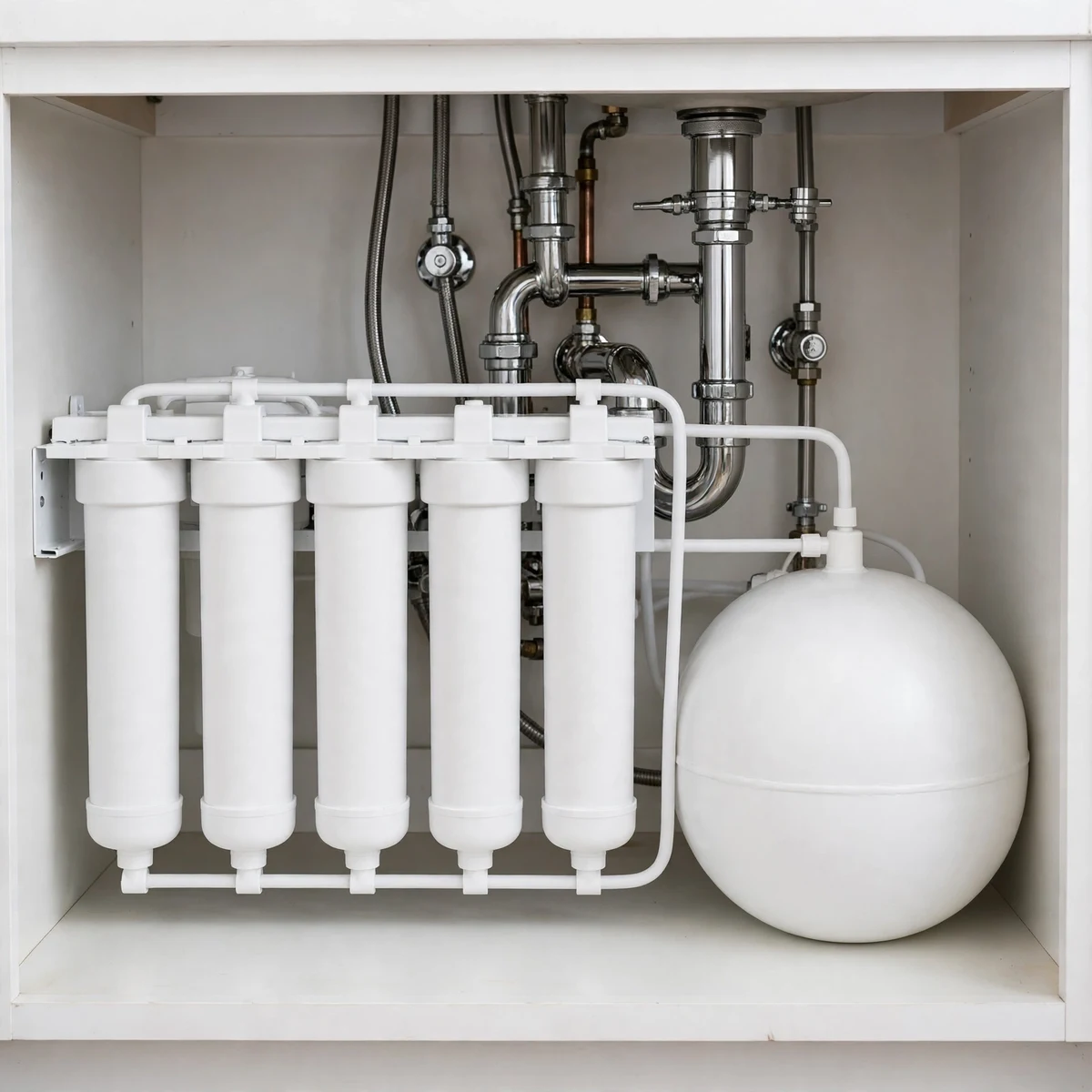
Strip away the branding and these two are remarkably similar machines: five stages, white 10-inch housings, a pressurized storage tank, a dedicated faucet, no electricity. The real differences are smaller than most “vs” articles admit — for the wider RO landscape, see our best reverse osmosis systems roundup.
| iSpring RCC7 ★ Winner | APEC ROES-50 | |
|---|---|---|
| Stages | 5 | 5 |
| Membrane rating | 75 GPD | 50 GPD at 60 psi (~30 GPD at 50 psi) |
| Storage tank | 3.2-gallon pressurized | 4-gallon pressurized |
| Waste-to-pure ratio | ~3:1 (per reviewers) | 3:1 claimed; third-party tests measured up to 5:1 worst case |
| Feed pressure | ~45 psi minimum (below that: RCC7P pump version) | 40–85 psi; output drops with pressure |
| Remineralization | No (that is the RCC7AK sibling) | No (that is the ROES-PH75 sibling) |
| Certification | NSF/ANSI 58, issued by NSF itself | WQA Gold Seal, NSF/ANSI 58 — listed for TDS reduction |
| Street price | ~$180–230 (estimate) | ~$180–230 (estimate) |
| Yearly filter cost | ~$50–60 (estimate) | ~$40–50 (estimate) |
| Best for | Fast recovery, heavy daily use | Biggest ready supply, lowest running cost |
iSpring RCC7 — the faster refill
Pros
- 75 GPD output — 50% more production; the tank refills faster after heavy use.
- NSF-issued certification to NSF/ANSI 58 — the strongest cert paperwork at this price.
- Exceptional support reputation — long-term owners report free replacement parts years after purchase.
Cons
- Smaller 3.2-gallon tank — less ready water when everyone fills bottles at once.
- Needs ~45 psi minimum — low-pressure homes must step up to the RCC7P pump version.
- Arrival QC nits — several owners report broken plastic caps or dented faucet parts in the box.
Price checked at time of writing; it changes often — see the live price before you buy.
APEC ROES-50 — the bigger ready supply
Pros
- 4-gallon tank — the biggest ready supply in the classic tanked class.
- Lowest yearly cost — roughly $40–50 a year, the cheapest RO to run we found.
- Decades of owner goodwill — consistently praised as easy to install with clear instructions.
Cons
- Only 50 GPD — and output drops toward 30 GPD at 50 psi, so recovery is slow in low-pressure homes.
- Narrower cert scope — the WQA listing covers TDS reduction; the long contaminant list is marketing, not certified claims.
- Fiddlier filter changes — cartridge-in-housing design needs the supplied wrench and patience.
Certifications: what’s actually certified
Most comparison articles get this section wrong, so read it slowly. Both systems are legitimately certified to NSF/ANSI 58, the standard for point-of-use reverse osmosis — but the certificates differ. The RCC7’s listing is issued by NSF itself. The ROES-50 carries the WQA Gold Seal against the same standard, and an October 2026 check of the certification databases found its listing covers TDS reduction — real and meaningful, just narrower than APEC’s marketing page implies.

Here is the trap: APEC’s copy lists fluoride, arsenic, lead, and chromium among removed contaminants, and iSpring claims “up to 99% of 1,000+ contaminants.” Both are marketing claims, not individually certified reductions. In practice both membranes will reject a huge share of dissolved contaminants — that is what RO membranes do — but if lead or fluoride is your hard requirement, look up the exact model at info.nsf.org before buying.
One honest footnote for shoppers eyeing the RCC7’s alkaline sibling: a 2026 third-party lab test of an RCC7 fitted with a remineralization add-on (the AK-style stage) found the system introduced arsenic and vanadium into the water — the mineral media was the likely source. That finding does not apply to the plain RCC7 or the ROES-50, which add nothing back. Our RCC7 vs RCC7AK comparison covers the alkaline question in full.
Cost per year: the real math
The sticker price is the least important number here — both sell in the same ~$180–230 band (estimates; street prices move). The running cost is where the APEC genuinely wins.

| Item | iSpring RCC7 | APEC ROES-50 |
|---|---|---|
| Pre-filters (stages 1–3) | Every 6–12 months | Every 6–12 months |
| RO membrane | Every 2–3 years | Every 2–4 years (city water) |
| Post-carbon polish | Every 6–12 months | With the membrane, every 2–4 years |
| Estimated yearly total | ~$50–60 | ~$40–50 |
One caveat: your water moves these numbers more than the brand does. Change pre-filters every 6 months instead of 12 and either system’s cost climbs past $100 a year — one third-party estimate puts the APEC at ~$75/year at 40 gallons per month. Over five years the APEC saves roughly the cost of a nice dinner: real money, but not the deciding factor alone. Full category breakdown in our RO system yearly cost guide.
What owners actually complain about
Wastewater, both of them. Roughly 3 gallons down the drain for every gallon of drinking water — and one third-party lab measured the APEC at up to 5:1 in worst-case conditions. Brand claims assume ideal pressure and temperature; your kitchen is not a lab. On a well or tiered pricing it matters; tankless wastes far less — see our tank vs tankless RO guide.

Slow recovery when the tank runs dry. Both sound like plenty until you drain the tank filling pasta pots and the faucet slows to a trickle. The RCC7’s higher output is its genuine edge — it rebuilds pressure noticeably faster. If your house treats the RO faucet like a second tap, that is the difference you will feel.
Build-quality nits. RCC7 owners report broken plastic caps, a dented faucet, or all-plastic valves on arrival. APEC owners have a smaller but scarier thread: cracked filter housings discovered after a couple of years, leaking “out of nowhere.” Neither is common; both are worth knowing.
The support contrast is real. iSpring has the cult following: the story of a 2013 RCC7 owner who got a free replacement system from support after a housing-cap leak is not an isolated anecdote. APEC owners mostly praise the installation: clear instructions, good videos, a pre-pressurized tank. Different strengths, both legitimate.
Which should you buy?
After the spec sheets, the databases, the cost math, and the owner threads — here is the decision in plain terms.

Buy the iSpring RCC7 if
- Your household uses the RO faucet heavily and the tank keeps running dry — 75 GPD is the fastest recovery in this class.
- You want NSF-issued certification — the strongest third-party paperwork at this price.
- You value support reputation — iSpring’s long-term owner stories lead the category.
Buy the APEC ROES-50 if
- You want the most ready water on tap — the 4-gallon tank is ~25% bigger.
- You want the lowest yearly running cost — roughly $40–50 a year.
- You have middling water pressure — 40–85 psi is more forgiving than the RCC7’s ~45 psi minimum.
Skip both if
- Feed pressure is below ~45 psi — get the pump version (iSpring RCC7P).
- You want mineralized/alkaline-tasting water — see the alkaline siblings (RCC7AK, APEC ROES-PH75) with the lab caveat above.
- You are filtering whole-house or well water — the iSpring WGB32B (or WGB32BM for iron-heavy well water) is the right tool.
Price checked at time of writing; it changes often — see the live price before you buy.
Price checked at time of writing; it changes often — see the live price before you buy.
FAQs
Which is better — the iSpring RCC7 or the APEC ROES-50?
Neither clearly wins. The iSpring RCC7 produces water faster (75 GPD vs. 50 GPD) and recovers quicker after heavy use. The APEC ROES-50 stores more ready water (4-gallon tank vs. 3.2) and costs less per year to run (~$40–50 vs. ~$50–60, estimates). Pick by priority: recovery speed or ready supply.
Is the APEC ROES-50 NSF certified?
It carries the WQA Gold Seal against NSF/ANSI 58, and an October 2026 database check found its listing covers TDS reduction. It does not carry individually certified claims for lead or fluoride, even though APEC’s marketing lists them — verify any specific claim at info.nsf.org.
Does the iSpring RCC7 remove fluoride and lead?
No — not as a certified claim. “Up to 99% of 1,000+ contaminants” is iSpring’s marketing, not a per-contaminant certification; the plain RCC7’s NSF/ANSI 58 listing is not individually scoped to lead or fluoride. (The broader listing belongs to the RCC7AK-BN/BLK variants, a different model.)
Which one costs less per year to run?
The APEC ROES-50: roughly $40–50 per year vs. roughly $50–60 for the RCC7 (five-year estimates). Your water quality moves these numbers more than the brand does.
Do these systems waste a lot of water?
About 3 gallons down the drain per gallon of drinking water — typical for tanked RO. Third-party testing measured the APEC as high as 5:1 in worst-case conditions (low pressure, cold water). For 1–2 gallons a day the absolute waste is modest; on a well or tiered pricing, tankless wastes far less.
Can I install either system myself?
Yes — both are DIY installs taking one to two hours with basic tools. APEC owners especially praise the instructions and videos. Below about 45 psi of feed-water pressure, neither base model is the right pick — look at a pump version instead.
Conclusion
There is no bad choice here, only a choice of priorities. The iSpring makes water faster and carries the NSF-issued certificate; the APEC stores more of it and costs less to keep running. Both waste about the same water, both install in an afternoon, and both will end your bottled-water habit. Check your water pressure, count how many glasses your household actually drinks, and pick the machine that matches your kitchen — not the one that won some other site’s trophy.
Price checked at time of writing; it changes often — see the live price before you buy.
Price checked at time of writing; it changes often — see the live price before you buy.
Update log
- Zulqarnain: Review published.