
RO vs Whole House Water Filter (2026): Which Should You Buy?
Your tap water tastes faintly like a swimming pool, or your shower leaves your skin itchy — or you have read about lead and PFAS and wonder whether your kitchen tap is actually safe. Then you start shopping and hit the big fork in the road: a reverse-osmosis system under the sink, or a whole-house filter on the main water line. Two completely different machines, two completely different prices — and every product page insists it is the answer.
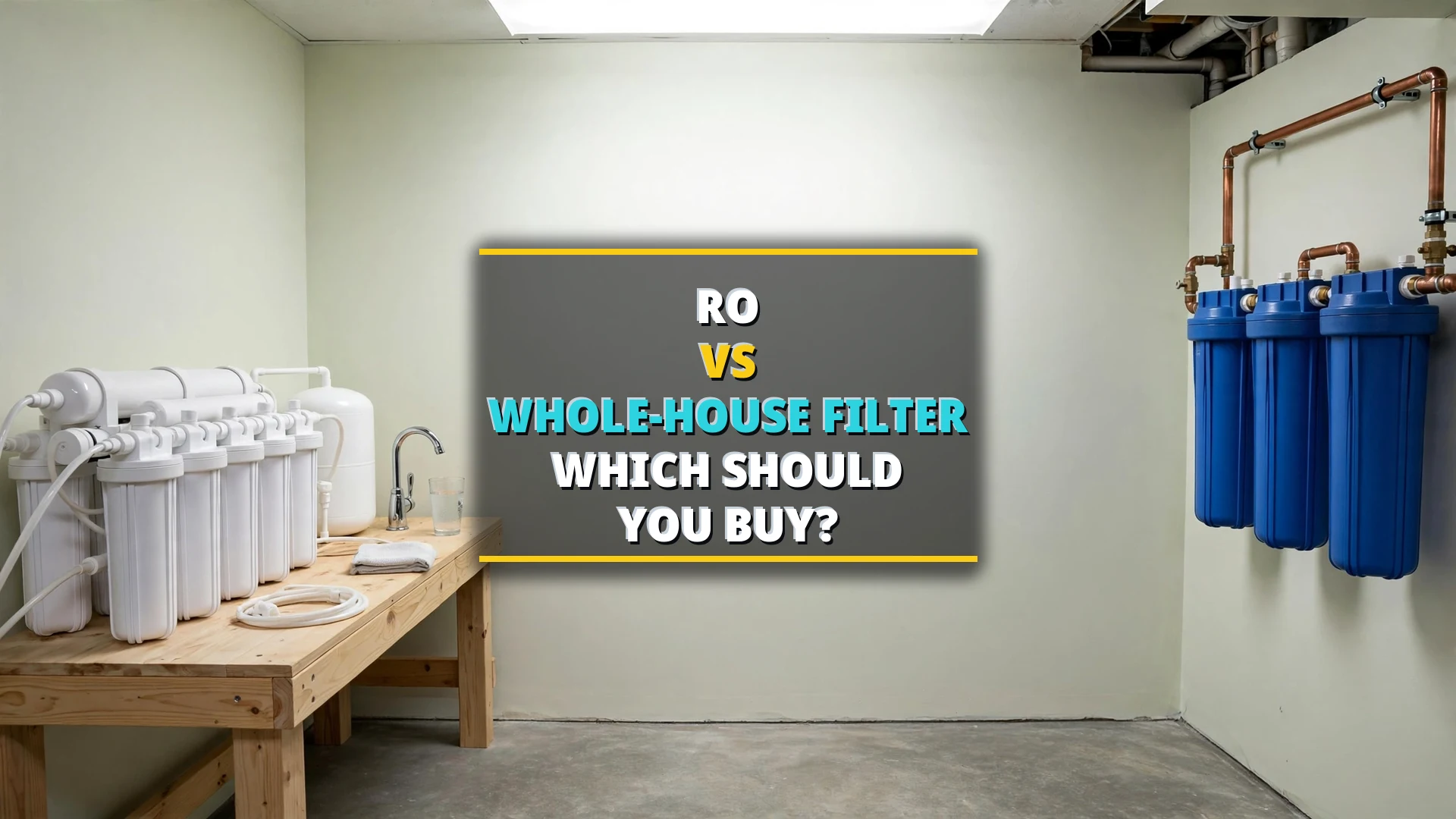
Here is the short answer: they solve different problems. An under-sink RO system makes the purest drinking water at one tap — the right tool for dissolved contaminants like lead, fluoride, nitrates, and PFAS. A whole-house filter treats every tap in the home — the right tool for chlorine taste and odor, sediment, and protecting your plumbing. Many homes end up needing both, because neither machine does the other’s job. This comparison covers what each system does, what each costs over five years, what the certifications really mean, and what owners say — so you buy the right machine for your actual water problem.
Whole-house filter — every tap, chlorine and sediment handled
iSpring WGB32B
~$230–280
Treats every tap in the home — chlorine, sediment and plumbing protection at full household flow with no wastewater — but it does not remove fluoride or dissolved lead.
Under-sink RO — the purest water, at one tap
Geekpure 5-Stage RO
~$130–220
The broadest contaminant removal at the tap — lead, fluoride, nitrates and PFAS — with DIY installation in about an hour and roughly $50–150 a year in filters.
The bottom line: an under-sink RO system and a whole-house filter answer two different questions. RO answers “is my drinking water safe from dissolved contaminants?” Whole-house answers “is the water everywhere in my home clean, good-tasting, and easy on my pipes?” Drinking-water worry — lead, fluoride, nitrates, PFAS — means RO. Every-room problems — chlorine smell, sediment, scale — mean whole-house. Have both? Budget for both: a whole-house sediment pre-filter even extends the life of an RO membrane by catching grit first.
Verdict: diagnose the problem first, then buy. Drinking-water worry → under-sink RO. Every-tap problem → whole-house filter. Both problems → both systems.
Prices are estimates checked at time of writing; they change often — see the live price before you buy.
Table of Contents
Side-by-side comparison

Before the details, here is the whole comparison on one screen. The rows that matter most are coverage and contaminant scope — everything else is a consequence of those two.
| Under-sink RO ★ Winner | Whole-house filter | |
|---|---|---|
| Coverage | One tap (usually the kitchen) | Every tap in the home |
| What it removes | Dissolved contaminants: lead, arsenic, nitrates, fluoride, PFAS, most dissolved solids | Sediment, chlorine, taste and odor, some VOCs |
| Fluoride | Yes — roughly 95–98% per brand data | No |
| Dissolved lead | Yes — the right tool at the drinking tap | Not the tool for it — carbon stages target taste, not dissolved metals |
| Chlorine taste and odor | Yes | Yes — this is its home turf |
| Sediment and rust | Pre-filters catch some, but heavy sediment shortens filter life | Yes — a core job |
| Softens hard water | No — though it removes the dissolved minerals | No — hardness needs a softener, a separate category |
| Minerals in water | Removed (remineralization add-ons exist) | Retained |
| Flow rate | Slow — fills a storage tank (typical tanked units rated 50–100 GPD, real output lower) | High — 10–25 GPM, full household flow |
| Wastewater | Roughly 3 gallons down the drain per gallon made (tanked systems) | None |
| Typical upfront (estimate) | ~$130–220 (value 5-stage) | ~$230–280 (value 3-stage) to ~$900–1,100 (long-life tank system) |
| Yearly upkeep (estimate) | ~$50–150 | ~$100–300 |
| Installation | DIY — about an hour, basic tools | Plumber recommended — it cuts into the main water line |
| Best for | Renters, city water, drinking-water safety | Homeowners, well water, every-tap problems |
Under-sink RO — the purest water, at one tap
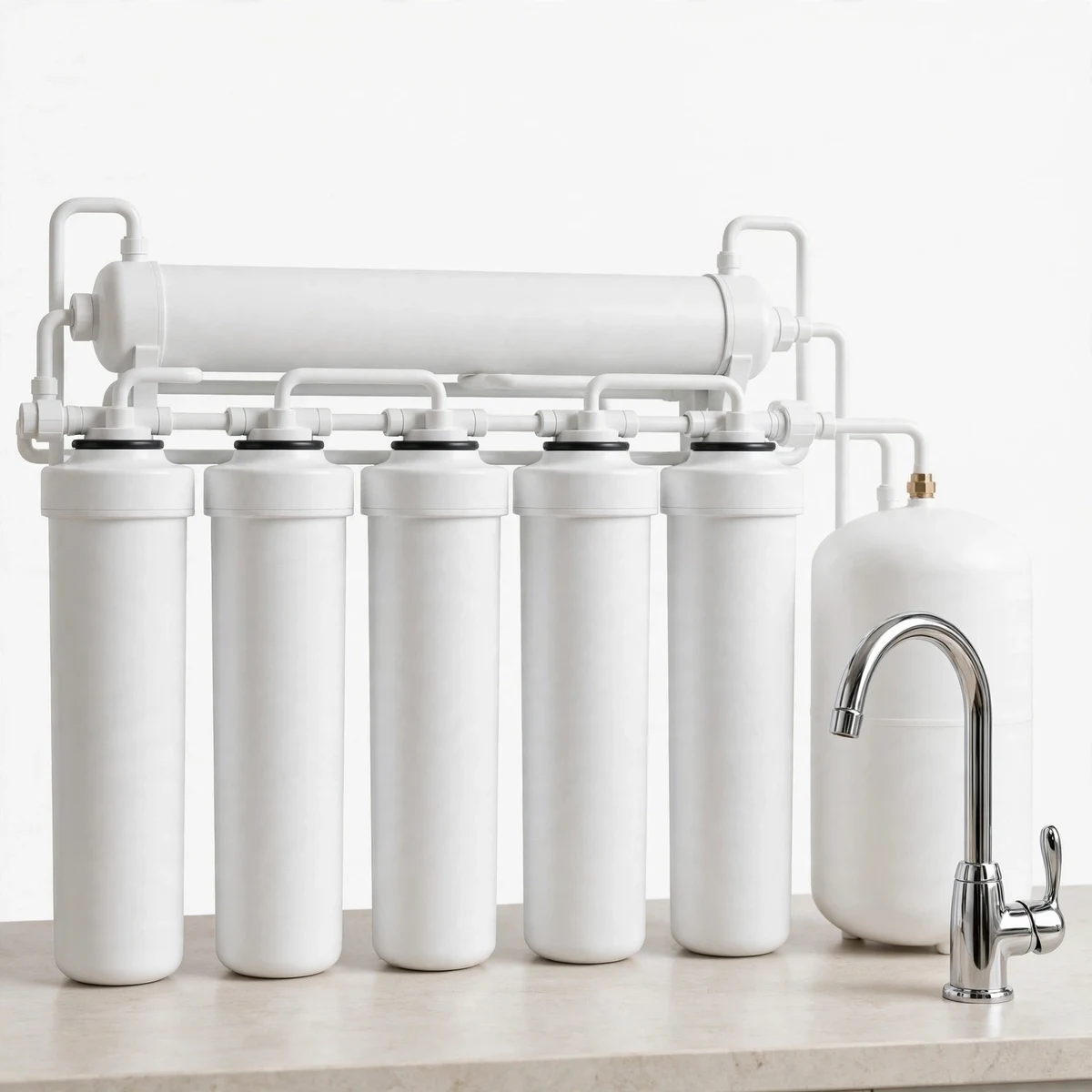
An under-sink RO system pushes tap water through sediment and carbon pre-filters, a reverse-osmosis membrane, and a polishing post-filter. The membrane is the star: it rejects dissolved contaminants — lead, arsenic, nitrates, fluoride, PFAS — far beyond what carbon cartridges can do. The Geekpure 5-stage RO is the category’s value representative at roughly $130–220 (estimate); our best RO systems roundup compares the top models, and our tank vs tankless guide covers that separate decision.
Pros
- Broadest contaminant removal at the tap — dissolved lead, fluoride, nitrates, PFAS, arsenic: the full dissolved-contaminant list.
- Low upfront cost — a value 5-stage system costs less than most whole-house hardware alone.
- DIY installation — owners consistently report about an hour with basic tools.
- Cheap yearly upkeep — roughly $50–150 a year in filters (estimate).
- Verifiable results — owners measure single-digit TDS readings with a $20 handheld meter.
Cons
- One tap only — your shower, laundry, and bathroom taps get nothing.
- Wastes water — tanked systems send roughly 3 gallons to drain for every gallon of drinking water.
- Strips minerals too — the flat taste bothers some people; remineralization stages exist as add-ons.
- Slow output — real-world production runs noticeably below the rated GPD, worse on low feed pressure.
Whole-house filter — every tap, chlorine and sediment handled
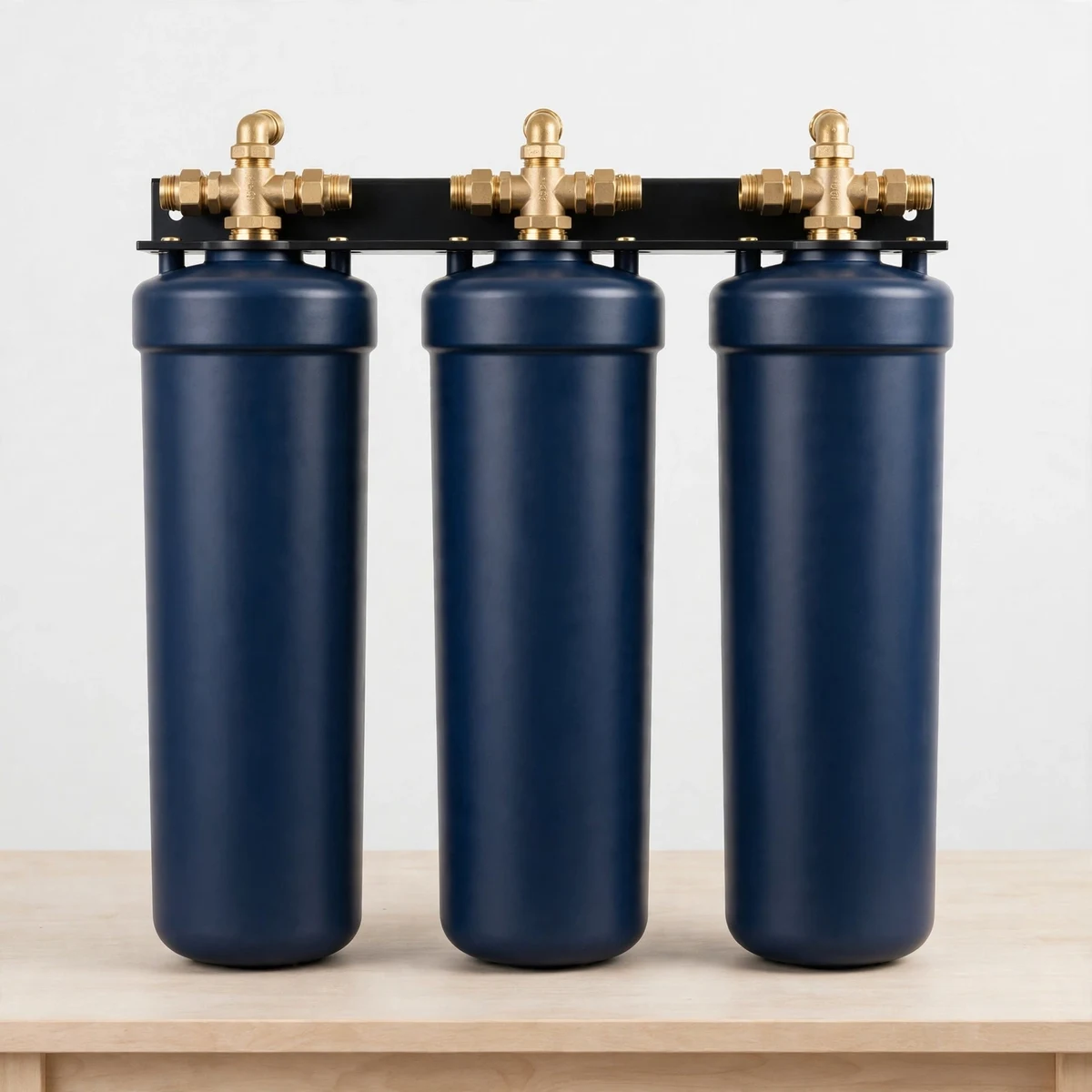
A whole-house system sits on the main water line and treats everything downstream — showers, laundry, dishwashers, every faucet. The typical setup is staged: a sediment pre-filter first, then carbon for chlorine, taste, and odor. The iSpring WGB32B (roughly $230–280, estimate) is the value 3-stage pick at 15 GPM; the Aquasana EQ-1000 Rhino (roughly $900–1,100, estimate) is the long-life tank approach. Our Aquasana HealthShield review covers the premium all-in-one route.
Pros
- Every tap covered — chlorine-free showers, better-tasting water everywhere, no second thought.
- Protects plumbing and appliances — sediment and scale stay out of your water heater, dishwasher, and pipes.
- High flow, no waiting — 10–25 GPM means the shower never trickles because the filter is working.
- No wastewater — what goes in comes out, minus the contaminants.
- Extends RO membrane life as a pre-filter by catching sediment first.
Cons
- Does not remove fluoride — if fluoride is your concern, this is the wrong machine.
- Not the tool for dissolved lead, PFAS, or nitrates — carbon stages target taste and odor, not dissolved contaminants.
- Does not soften hard water — hardness minerals pass right through; that needs a softener.
- Higher total cost — hardware plus a plumber for the main-line install, and bigger, pricier filter changes.
Certifications
Certification is where this comparison gets honest — and where marketing gets the most slippery. We could not verify these listings in the live certification database from this desk, so this section states exactly what each claim’s basis is and tells you how to check it yourself.

| System | Claim | Basis |
|---|---|---|
| Geekpure 5-stage RO | No verified certification found | We found no NSF, WQA, or IAPMO listing we could verify — treat listing claims as unverified until you check them yourself |
| iSpring WGB32B | Brand-stated specs (3-stage, 15 GPM) | Certifications unverified — check info.nsf.org or the WQA product directory before buying |
| Aquasana EQ-1000 Rhino | NSF/ANSI 42 (brand-stated) | Brand and retailer listings — verify the current listing at info.nsf.org; broader certification claims sometimes attached to this product line have been disputed, and only the certifier’s database settles it |
| Category fact | NSF/ANSI 58 covers RO systems; 42 covers aesthetic effects (chlorine taste and odor); 53 covers health effects (lead, cysts); 401 covers emerging contaminants | NSF standard definitions — match the number to your contaminant |
How to check yourself: search the model name at info.nsf.org or the WQA product directory and read the exact listed claims. A system-level NSF/ANSI 58 listing means the RO system met the standard’s requirements — not a line-by-line guarantee for every contaminant named in ads. Marketing claims without a certification number are just words.
The most important honesty note in this section: a whole-house carbon filter’s certification scope is usually aesthetic — NSF/ANSI 42 territory, meaning chlorine, taste, and odor. It is not certified for dissolved lead or PFAS. If either of those is your actual concern, that is an RO problem, not a whole-house problem — and no marketing paragraph changes the chemistry.
Cost per year
The sticker price is the least important number on this page. What matters is the five-year cost of owning the thing — hardware, install, and every filter change — because water filtration is a subscription you pay in cartridges.

| Value under-sink RO (Geekpure 5-stage) | Value whole-house (iSpring WGB32B) | Premium whole-house (Aquasana Rhino) | Both (value combo) | |
|---|---|---|---|---|
| System (estimate) | ~$130–220 | ~$230–280 | ~$900–1,100 | ~$360–500 |
| Installation | DIY (~$0) | Plumber (~$200–500) | Plumber (~$300–600) | Plumber + DIY |
| Filters per year (estimate) | ~$50–150 | ~$100–200 | ~$100–200 | ~$150–350 |
| 5-year total (estimate) | ~$380–970 | ~$930–1,780 | ~$1,700–2,700 | ~$1,300–2,750 |
Two things jump out. First, the RO wins on pure cost at every step — cheaper hardware, free installation, cheaper filters. The case for whole-house was never cost; it is coverage. Second, the “both” column is the number most buyers skip: a value whole-house filter plus a value RO costs roughly what the premium whole-house system alone costs over five years. For deeper math on either side, see our RO system yearly cost breakdown and our whole-house water filter cost guide.
RO’s hidden cost is water, not money: tanked systems send roughly 3 gallons down the drain for every gallon of drinking water. At 1–2 gallons a day, the absolute waste is modest — it only stings on well water or tiered pricing. (Whole-house RO is a different animal at $3,000–8,000+ installed — this guide compares under-sink RO, the sane residential choice.)
Owner voices
We read owner reviews across retail listings and forums to find the complaints that repeat — not one-off bad luck, but patterns. Here is what keeps coming up for each type of system.

Under-sink RO owners talk about the TDS meter moment — watching the reading drop from the hundreds into single digits. That number is the whole reason they bought the system, and they check it like a hobby. Installation earns consistent praise as a genuine one-hour DIY job. The recurring complaints are the category’s usual suspects: slow tank recovery that big families notice, the ~3:1 wastewater ratio, and pre-filters needing changes every 6–12 months — skip those and the membrane dies early, the expensive lesson owners warn each other about.
Whole-house filter owners talk about the shower. The recurring theme is chlorine smell disappearing from hot water, skin and hair feeling better within weeks, and — for well-water owners — sediment no longer clogging faucet aerators. The recurring complaints are about everything around the filter rather than the filtration: the plumber bill, the size and weight of replacement cartridges, and the discovery that hard water is untouched — several owners admit they bought a filter expecting softer water and learned the softener lesson the expensive way.
The pattern across both: owners who tested their water first and bought for a specific problem are happy; owners who bought a machine and hoped it would fix everything are the ones writing the one-star reviews.
Which should you buy?
This was never a which-is-better contest. It is a which-problem-do-you-have decision — and most households can answer it in thirty seconds at the tap.

Buy the under-sink RO if
- Your worry is drinking-water safety — lead, fluoride, nitrates, PFAS, or the highest-purity water you can get.
- You rent, or you cannot modify the main plumbing.
- Your city water is otherwise fine — no sediment, no chlorine complaints beyond the glass.
- Budget is tight — it is the cheapest way to genuinely clean drinking water.
Buy the whole-house filter if
- Chlorine or sediment affects every room — showers, laundry, fixtures, not just the glass.
- You are on well water with sediment, rust, or odor issues.
- You want to protect the water heater, dishwasher, and pipes from sediment and scale.
- You own the home and can invest in the plumbing.
Buy both if
- You have both problems — well-water sediment plus drinking-water worries, for example.
- You are building or renovating and the walls are already open.
- Your budget allows it — the value combo costs about the same over five years as one premium whole-house system, and the pre-filter extends the RO membrane’s life.
FAQs
Can I use a whole-house filter instead of reverse osmosis?
Only for chlorine, taste, odor, or sediment. A whole-house filter does not remove fluoride, and it is not the tool for dissolved lead, PFAS, or nitrates — those need reverse osmosis at the drinking tap. The two systems solve different problems, so one cannot substitute for the other.
Do I need both a whole-house filter and an RO system?
Not everyone — diagnose first. If your water report shows house-wide sediment or chlorine plus dissolved contaminants you care about at the tap, both earn their keep — and the whole-house pre-filter extends the RO membrane’s life by catching grit first. One problem on the report means buying one system.
Does a whole-house water filter remove fluoride?
No. Standard whole-house carbon and sediment systems do not remove fluoride — it is a dissolved mineral that passes through them. Reverse osmosis removes roughly 95–98% per brand data, which is why fluoride-concerned buyers choose an under-sink RO at the kitchen tap.
Will a whole-house filter soften my hard water?
No. Filters remove particulates, chlorine, taste, and odor — they do not remove the dissolved calcium and magnesium that make water hard. Softening requires a water softener (ion exchange) or a scale conditioner, which is a separate treatment category. Do not buy a filter expecting softer water.
Which costs more to run each year — RO or whole-house?
The whole-house system, by a clear margin: roughly $100–300 a year in filters (estimate) versus roughly $50–150 for a value under-sink RO — plus the whole-house install usually needs a plumber while the RO is DIY. Over five years: roughly $380–970 for the RO versus roughly $930–1,780 for a value whole-house system (estimates).
Does reverse osmosis waste a lot of water?
Tanked under-sink RO sends roughly 3 gallons down the drain per gallon of drinking water made — but at 1–2 drinking gallons a day, the absolute waste is modest. It only stings on well water or tiered pricing. Whole-house RO is far thirstier, which is why this guide compares under-sink RO.
Can I install these systems myself?
An under-sink RO, yes — about an hour with basic tools; the kits are designed for DIY. A whole-house filter cuts into the main water line, so most buyers hire a plumber — budget roughly $200–500 for the install (estimate, varies by market).
Conclusion
RO versus whole-house was never a fair fight, because they were never fighting over the same job. Under-sink reverse osmosis gives you the purest drinking water at one tap for the least money. A whole-house filter gives every tap in your home cleaner, better-tasting water and protects your plumbing. Figure out which problem you actually have — test the water if you are not sure — and buy the machine that solves it. And if you have both problems, the honest answer is both machines: the only combination that covers the whole house and the glass.
Prices are estimates checked at time of writing; they change often — see the live price before you buy.
Update log
- Zulqarnain: Review published.