


HAF-QIN vs HAF-CIN (2026): Which Should You Buy?
Your Samsung fridge’s filter indicator just turned red, and the search results are showing you two nearly identical model numbers — HAF-QIN and HAF-CIN. One letter apart. Retailer listings print both codes in the same title, some listings call them “the same filter,” and a few even invent a “HAF-CIN cartridge” that does not exist. For what should be a ten-minute swap, it is a genuinely confusing two-code maze.
Here is the short answer, and it is not what the listing titles suggest: HAF-CIN is not a typo, and it is not a knockoff label — it is a real Samsung cartridge designation. But neither code is “better” in any meaningful sense, because your refrigerator already decided this matchup. This comparison walks through what each code actually means, where Samsung uses each one, the brand-stated certification difference between them, the yearly cost math, and the one fit check that matters before you spend a dollar.
The international designation
Samsung HAF-CIN
Varies — less common at US retail
The designation Samsung uses on its international product pages (AU, UK, CA, NZ) — the same slim cartridge family, with brand-stated NSF/ANSI 42 + 53 on those regional pages.
The top-pick US designation
Samsung HAF-QIN
~$30–60
The designation Samsung uses in the US for the cartridge sold at retail as the Samsung DA29-00020B — the widest US retail stock, with brand-stated NSF/ANSI 42 only.
The bottom line: buy the filter your fridge’s manual or your existing cartridge’s label names — not the one with the nicer listing. HAF-QIN is the designation Samsung uses in the US for the cartridge sold at retail as the Samsung DA29-00020B. HAF-CIN/EXP is the designation Samsung uses on its international product pages (Australia, UK, Canada, New Zealand) for the same slim cartridge family — and Samsung’s own international pages list broader certification claims for it. To make the maze worse, Samsung’s own international HAF-CIN pages list DA29-00020B as a model reference under the HAF-CIN spec, so the same code shows up under both names.
Verdict: match the manual, not the marketing — the performance question is decided by which code your fridge takes.
Prices checked at time of writing; they change often — see the live price before you buy.
Table of Contents
Side-by-side comparison
The headline numbers below come from Samsung’s own regional product pages — the AU/UK/CA listings for HAF-CIN/EXP and the US listings for the DA29-00020B (the retail name of the HAF-QIN). Every row is manufacturer-stated, not a marketing bullet point.

| Samsung HAF-QIN ★ Winner | Samsung HAF-CIN | |
|---|---|---|
| What it is | Genuine Samsung designation | Genuine Samsung designation (HAF-CIN/EXP) |
| Where Samsung uses the code | US designation — retail boxes sold as DA29-00020B | International designation — Samsung AU, UK, CA, NZ product pages |
| Fridge types (per brand pages) | Samsung French-door models | Samsung French-door & side-by-side models (Samsung Canada’s HAF-CIN page names RF263BEAESR, RF28HFEDBSR and others) |
| Rated capacity | 300 gallons | 300 gallons |
| Change interval | Every 6 months | Every 6 months |
| Install style | 90° rotate-and-lock | 90° rotate-and-lock |
| Brand-stated certifications | NSF/ANSI 42 only (Samsung US listings) | NSF/ANSI 42 + 53 (Samsung AU/UK/CA product pages) |
| Street price (estimate) | ~$30–60 genuine 2-pack | Varies — less common at US retail |
| Database check | Neither certification was independently verified at info.nsf.org during research — check the database yourself if certification proof matters to you | |
The one fit check that matters: do not trust a listing title that prints both model numbers — sellers copy both into titles for search visibility, and that tells you about their SEO, not about the cartridge in the box. Check your fridge’s use & care manual for the exact filter designation, and read the code printed on your current cartridge. Our HAF-QIN replacement guide walks through the fit check for the US designation. The same fit-first logic shows up across brands — it is the same reasoning behind our WF3CB vs ULTRAWF comparison.
Samsung HAF-QIN — the top-pick US designation
HAF-QIN wins when
- Your fridge or cartridge says HAF-QIN. That is the US-market designation — matching it exactly removes all fit guesswork.
- You are buying in the US. Retail boxes are sold as the DA29-00020B, which is the same cartridge our DA29-00020B replacement guide covers step by step.
- You want the widely stocked option. US retail availability is deeper for this designation.
Samsung HAF-CIN — the international designation
HAF-CIN wins when
- Your fridge or cartridge says HAF-CIN. Samsung assigns this designation to a long list of French-door and side-by-side models — match the code, not the region.
- You buy Samsung filters outside the US. The HAF-CIN/EXP designation is the one Samsung’s international stores sell.
- Certification breadth matters to you. Samsung’s international product pages list NSF/ANSI 42 plus 53 for this designation (see the Certifications section for the caveats).
Certifications
This section is where listing titles go wrong and where the honest answer needs care. Samsung’s US listings for the DA29-00020B — the retail name of the HAF-QIN — show certification to NSF/ANSI 42 only, per our earlier research on Samsung’s own listings and the NSF database. Not 53, not 401. That is the binding line: the HAF-QIN carries 42-only certification claims, and any listing showing more is embellishing.

Samsung’s international HAF-CIN/EXP product pages (Australia, UK, Canada) state more: NSF/ANSI 42 plus NSF/ANSI 53, with the 53 scope on the spec sheet covering cysts, turbidity, lead, asbestos, benzene, carbofuran, p-dichlorobenzene and mercury, and the 42 scope covering chlorine taste and odor. Those are Samsung’s brand-stated claims on its own regional pages — and one honest caveat applies to both columns: we could not verify either designation’s listing in the public NSF database at info.nsf.org during research, so treat Samsung’s statements as the source and check the database yourself if certification proof matters to you.
One claim we deliberately did not publish: a manual-aggregator page lists NSF 42, 53 and 401 for HAF-CIN/EXP. That 401 addition appears nowhere on Samsung’s own regional product pages, so we treat it as unverified and leave it out. Vague “tested to NSF standards” language on a third-party listing is not the same as a named standard on the manufacturer’s own page.
Cost per year
Fridge filters are a subscription you pay in cartridges, so the per-filter price matters less than the yearly total. Both designations are rated for 300 gallons or 6 months, whichever comes first — which means two changes a year under normal use.

| Item | HAF-QIN (genuine) | HAF-CIN (genuine) | HAF-CIN compatible (third-party) |
|---|---|---|---|
| Rated capacity | 300 gallons / 6 months | 300 gallons / 6 months | 300 gallons / 6 months (per listings) |
| Cartridges per year | ~2 | ~2 | ~2 |
| Street price (estimate) | ~$30–60 per 2-pack | Varies — less common at US retail | ~$20–30 each |
| Estimated yearly cost | ~$30–60 | Varies | ~$40–60 |
There is no cost advantage hiding anywhere in this comparison — the difference is availability, not arithmetic. Prices are estimates and bounce with sales; multi-packs usually trim the per-cartridge cost of the genuine filters. On the third-party column, one warning: a “compatible” cartridge that shows a badge-style certification icon but names no certifier has no independent proof behind any claim on its label. Check for a named certifier before you buy.
Owner voices
We researched and compared owner feedback across major retail listings for Samsung’s slim-cartridge filters. The recurring themes are consistent across both designations — which makes sense, since owners are buying the same physical cartridge family:
Installation is easy. The 90-degree rotate-and-lock swap is consistently described as a tool-free, few-minutes job: twist the old cartridge counterclockwise, pull, push the new one in, twist clockwise to lock. The most common friction point is forgetting to reset the filter indicator on the control panel — after which the red light stays on and owners worry the new cartridge “isn’t working.”
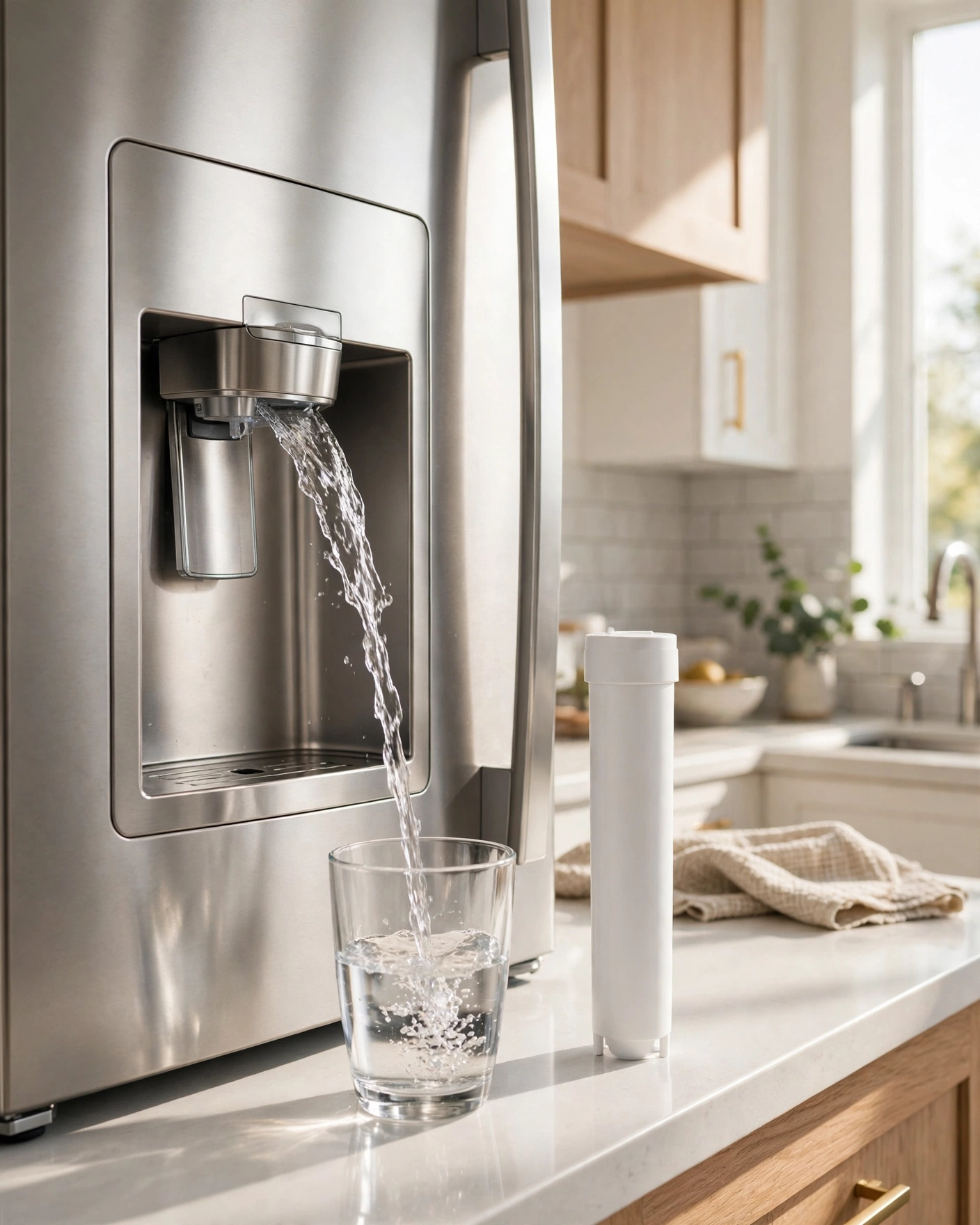
Taste and odor improve. Chlorine taste and off-odors disappearing is the most reported positive across listings — the one benefit nobody disputes, and the one the NSF/ANSI 42 scope backs.
Price stings as a subscription. Two cartridges a year adds up, and it is the complaint most likely to push owners toward cheap compatibles — the classic bad trade if the compatible names no certifier, because the slim Samsung housing is one of the most counterfeited cartridge shapes in the category. Buy from reputable sellers and check the packaging for certification marks.
The compatible debate splits owners. Third-party compatibles marketed for these designations get praise for price, and skepticism about certification proof. The deciding question owners should ask is the same one our research kept returning to: does the listing name a certifier, or does it just show a badge? That question is worth more than the price difference.
Which should you buy?

Buy the HAF-QIN if
- Your manual or current cartridge names the HAF-QIN — it is the US designation, and retail boxes are sold as the DA29-00020B.
- You are buying in the US and want the widest retail stock with the clearest genuine-vs-compatible market.
- You want the designation with the simplest certification picture — brand-stated NSF/ANSI 42 only.
Buy the HAF-CIN if
- Your manual or current cartridge names the HAF-CIN — Samsung assigns this designation to a long list of French-door and side-by-side models (Samsung Canada’s HAF-CIN page names RF263BEAESR, RF28HFEDBSR and others).
- You buy Samsung filters outside the US — the HAF-CIN/EXP designation is what Samsung’s international stores sell.
- Certification breadth matters to you — Samsung’s international pages list NSF/ANSI 42 plus 53 for this designation (with the database-verification caveat above).
Buy neither if
- You are tempted by a no-name listing with a badge icon but no named certifier — an uncertified cartridge has no independent proof behind any claim on its label, and this cartridge shape is heavily counterfeited.
- Your concern is something no fridge cartridge certifies — fluoride reduction, arsenic, or very high lead levels need a different product category (reverse osmosis), not a different fridge filter.
Still comparing across brands? Our LG LT1000P replacement guide and our EveryDrop EDR1RXD1/EDR2RXD1/EDR3RXD1 guide cover the other most-searched fridge cartridges the same way.
Prices checked at time of writing; they change often — see the live price before you buy.
FAQs
Is HAF-CIN the same as HAF-QIN?
No — they are two different genuine Samsung cartridge designations, and the confusion comes from Samsung reusing the same codes across regions. HAF-QIN is the designation Samsung uses in the US for the cartridge sold at retail as the Samsung DA29-00020B. HAF-CIN/EXP is the designation Samsung uses on its international product pages (Australia, UK, Canada, New Zealand), which list brand-stated NSF/ANSI 42 and 53. To make it messier, Samsung’s own international HAF-CIN pages list DA97-08006A-B and DA29-00020B as model references under the HAF-CIN spec — so the same code shows up under both names. The code printed on your existing cartridge or fridge manual is the one that counts.
Can I use a HAF-CIN filter instead of a HAF-QIN filter?
Only if your fridge takes it. Both are slim twist-in cartridges for Samsung French-door and side-by-side models, but Samsung assigns different filter families to different fridge models, and the model references overlap across regions. Do not assume a cartridge is right because a listing title prints both codes — sellers do that for search visibility. Check the code on your current cartridge and the filter model named in your fridge’s use and care manual; that combination is the only safe answer.
Is the HAF-QIN NSF certified?
Brand-stated NSF/ANSI 42 only. Samsung’s US listings for the DA29-00020B (the retail name of the HAF-QIN) show NSF/ANSI 42 certification — not 53 or 401. We could not verify the listing in the public NSF database at info.nsf.org during research, so treat the listing’s statement as the source and check the database yourself if certification proof matters to you.
Does HAF-CIN remove lead?
Samsung’s international HAF-CIN/EXP product pages state NSF/ANSI 42 plus NSF/ANSI 53, and list lead among the substances covered under the 53 scope on the spec sheet. That is Samsung’s brand-stated claim — we could not independently verify it in the public NSF database at info.nsf.org during research, so check there yourself if lead reduction is what you are buying for. We publish no percentage claims for either filter.
How often should I replace a Samsung HAF-QIN or HAF-CIN?
Every 6 months or 300 gallons, whichever comes first, per Samsung’s product pages. The cartridges use a 90-degree rotate-and-lock install — twist the old one counterclockwise to remove, clockwise to lock the new one in, then reset the filter indicator on your fridge’s control panel. A red light that stays on after a change almost always means the reset step was missed.
Conclusion
The HAF-QIN vs HAF-CIN question resolves more simply than the search results make it look: these are cousins in Samsung’s own filter family, not rivals — the HAF-QIN is the US designation sold at retail as the DA29-00020B, and the HAF-CIN is the designation Samsung uses on its international product pages. On paper they are near-twins: 300 gallons, 6 months, the same 90-degree rotate-and-lock install. The real differences are certification breadth on Samsung’s regional pages and which fridges each designation is assigned to — which is exactly why the code on your manual or existing cartridge wins over any listing title. Match that code, buy the genuine cartridge from a reputable seller, and reset the indicator when you swap it. The one thing neither designation forgives is a knockoff in the housing.
Prices checked at time of writing; they change often — see the live price before you buy.
Update log
- Zulqarnain: Review published.