


Best Whole-House Water Filters (2026): Buying Guide
Buyer’s guide
You notice it one tap at a time: a faint pool smell in the shower, rusty streaks in the toilet bowl, ice cubes that taste like the freezer. So you patch it one faucet at a time — a pitcher for the fridge, a shower filter, bottled water for the coffee — and every patch has its own cartridge, bill, and expiry date.
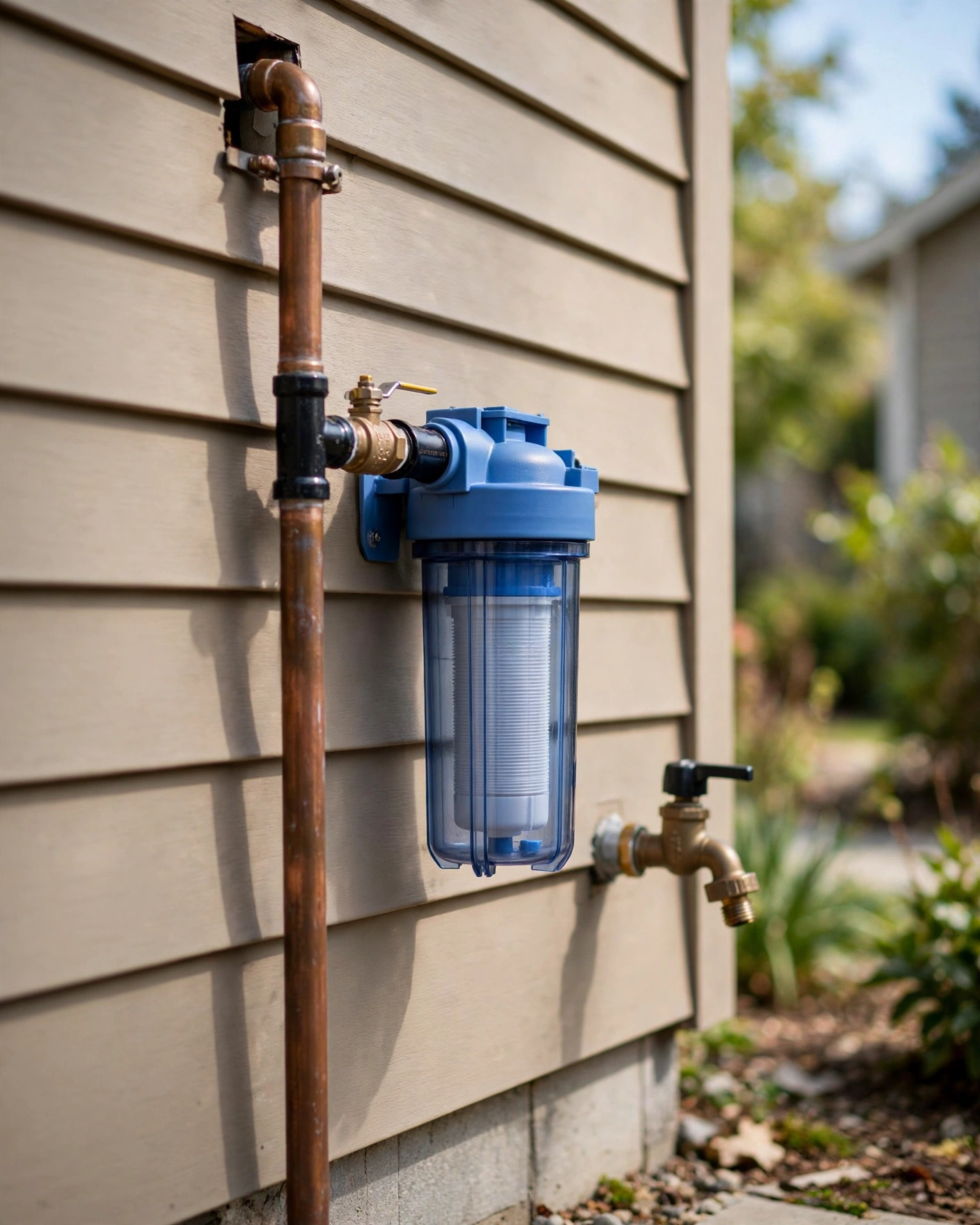
A whole-house water filter works the opposite way: it treats the water once, right where the main line enters your home, so every tap, shower, appliance, and ice cube draws from the same cleaner supply. One install, one maintenance schedule.
Below: three quick picks for most homes, how to size by flow rate so your shower never dribbles, two systems worth putting on your shortlist, and honest five-year ownership math.

Table of Contents
Quick Picks
Three picks for most homes. Choose the lane that matches your water source, then read the sizing section — an undersized whole-house filter is the most common and most avoidable mistake.
Check Current Price
Check Current Price
Check Current Price
One honest caveat: a whole-house filter treats all your water, but if drinking water is your only real concern, a dedicated drinking-water setup can be simpler and cheaper. If your only complaint is the kitchen tap, see our guide to under-sink RO systems before spending four figures on a whole-house unit.
How to Choose a Whole-House Filter
Whole-house systems look simple from the outside — a tank or a row of blue housings on the main line — but four decisions separate a system you love from one you resent.
1. Know your water source: city vs well
City water arrives treated, so your job is mostly taste and odor — chlorine residue — plus sediment and, in older neighborhoods, the possibility of lead leaching from old service lines or indoor plumbing. Well water skips the treatment plant, so you face whatever your aquifer carries: iron and manganese (the orange-stain culprits), sediment, sometimes sulfur smell. Test your water before you shop. Your utility’s annual quality report covers city water; well owners should use a test kit or lab test. Guessing is how people buy the wrong system twice.
2. Size by flow rate (GPM), not just house size
Every filter slows water down a little. Undersize the system and two showers running at once turn into a sad dribble. Match the unit to your home’s peak demand: add up what runs at the same time on a busy morning. A rough working method: each shower uses around 2–2.5 gallons per minute, each faucet or appliance around 1.5–2. Two showers plus a dishwasher means you want a system comfortably rated above 10 GPM. When in doubt, size up one step — a system running below its rated flow treats water better and lasts longer than one running flat out.
3. Pick the filter type that matches your patience
Most systems are built from three building blocks. A sediment pre-filter catches sand, rust flakes, and grit so later stages don’t clog. A carbon cartridge or carbon tank handles chlorine taste and odor. A tank-based system holds the media in a tall tank that can self-backwash — no cartridges to swap for years. Don’t confuse filters with softeners: a softener is a different machine (ion exchange for hardness) that sits next to your filter, not instead of it.
Cartridge systems
- Much cheaper up front (often a few hundred dollars)
- Compact — fits in tight utility spaces
- Easy to tailor stages for well water (iron, sediment, carbon)
Cartridge systems
- Cartridge swaps every 6–12 months, forever
- Flow rate often lower than tank systems
- Heavy-sediment wells burn through cartridges fast
Tank systems
- Media rated for years or hundreds of thousands of gallons
- Higher flow rates — comfortable for larger homes
- Self-backwashing designs clean themselves
Tank systems
- Four-figure upfront cost
- Taller, heavier — needs real floor space
- Usually a professional install
4. Shop by certification, not by marketing copy
This is where most filter marketing gets slippery. Three NSF/ANSI standards matter here: 42 covers aesthetic effects (chlorine taste and odor), 53 covers health effects (like lead), and 401 covers emerging contaminants (like pharmaceuticals). The key distinction: a brand saying “designed to reduce lead” is a marketing claim. A model listed in the NSF public database (info.nsf.org) under NSF/ANSI 53 is a tested claim. Same goes for WQA and IAPMO listings. Look up the exact model number in the public database before believing any contaminant-removal promise — never rely on the brand’s product page alone.

For the full landscape — how whole-house compares with pitchers, fridge filters, and the other types — see our main water filter hub. And if you’re torn between treating the whole house and just your drinking water, the whole-house vs point-of-use RO comparison covers that tradeoff directly.
Top Picks with Mini-Reviews
Two systems worth your shortlist — one from each camp. Most whole-house systems are variations on the same few designs; these two are the cleanest representatives of the budget-cartridge and premium-tank lanes.
SpringWell CF1 — best overall (tank-based)
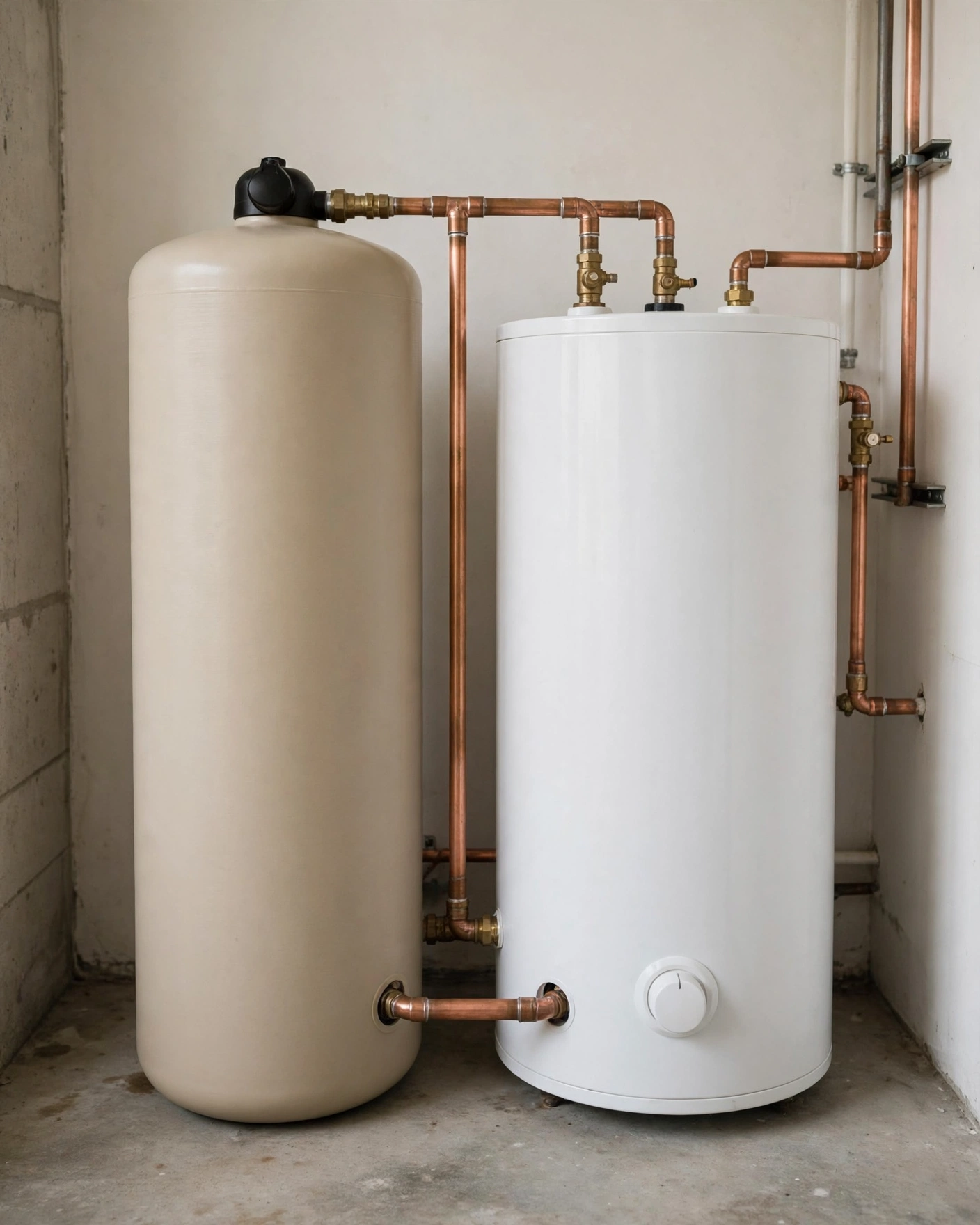
The CF1 is a single-tank system for city-water homes: a carbon-media tank plus a 5-micron sediment filter, designed to reduce chlorine taste and odor throughout the house. The headline is the media life — rated for around a million gallons or six years — which means no tank-media bill for years; the only recurring swap is the small sediment filter (roughly every 6–9 months, about $20 a pop). SpringWell backs it with a lifetime warranty on the tank and components.
Who it’s for: city-water homeowners who want the problem solved once and handled at a distance. If you’d rather never think about cartridges again, this is the shape of system you want.
Maintenance: light — the main tank needs no servicing within its rated media life (it has no backwash schedule); you just swap the small sediment filter every 6–9 months. Budget a plumber for install and you’re set for years.
The honest drawback: the upfront cost is four figures, professional install adds more, and it won’t soften hard water. Also: we could not confirm an NSF, WQA, or IAPMO certification listing for this model, so treat its contaminant-removal claims as unverified until you check info.nsf.org yourself for the exact model.
iSpring WGB32BM — best budget and best for well water (cartridge)
The WGB32BM is a three-stage cartridge system with a well-water mission: a fine sediment stage, then the iron-and-manganese stage targeting the minerals behind orange stains and metallic taste, finished with carbon for taste and odor. It’s one of the rare systems in this price range that takes well water seriously.
Who it’s for: well-water homeowners, and anyone who wants whole-house filtration without spending four figures. It’s also the sensible way to try the category before committing to a tank system.
Maintenance: cartridge swaps roughly every 6–12 months depending on how much sediment and iron your water carries. Heavy-iron wells eat the iron cartridge faster; that’s normal, not a defect.
The honest drawback: the cartridges are a permanent running cost, and flow drops as cartridges load up — very large households should size carefully and watch the pressure gauge. As with the CF1, we found no certification listing we could verify for this model: check the NSF, WQA, or IAPMO public databases for the exact model number before relying on any contaminant claim.

Still deciding whether a whole-house system is overkill? A pitcher filter is the cheapest first step while you think it over — a few dozen dollars buys you better-tasting drinking water today with zero commitment.
Whole-House Filters Compared
Side by side: exactly what the extra money buys. “Certification status” means what we could actually verify — for both models, that means: check the public databases yourself before relying on any contaminant claim.
| System | Type | Price range* | Filter/media life | Flow rate | Certification status | Best for |
|---|---|---|---|---|---|---|
| SpringWell CF1 | Tank | ~$1,000–1,200 | Media rated ~1M gallons or 6 yrs | 9 GPM service — sized for 1–3 baths | No listing verified — check info.nsf.org | City-water homes wanting set-and-forget |
| iSpring WGB32BM | 3-stage cartridge | ~$450–550 | Cartridges ~6–12 months | 15 GPM peak — size carefully for big homes | No listing verified — check info.nsf.org | Well water (iron/manganese) on a budget |
*Rough price estimates — check the listing before buying. Flow ratings vary; confirm the brand-stated rating for your setup.
Notice what the table really says: the price gap buys you absence of maintenance and flow-rate headroom, not necessarily cleaner water. If your well is heavy on iron, the cheaper system with the right cartridge can outperform a pricier tank designed for city water. Match the system to the water, not the price tag.
Cost of Ownership
Three cost layers: the unit, the install, and years of maintenance after. Here’s how they stack up over five years.
The three layers
1. The unit. Budget cartridge systems run several hundred dollars (the WGB32BM sits around $450–550). Tank systems run four figures (the CF1 around $1,000–1,200).
2. The install. This is plumbing on your main water line, so most people hire a licensed plumber — typically a few hundred dollars (roughly $300–800 depending on your market and how accessible the line is). Confident DIYers do install cartridge systems themselves; tank systems usually justify a pro.
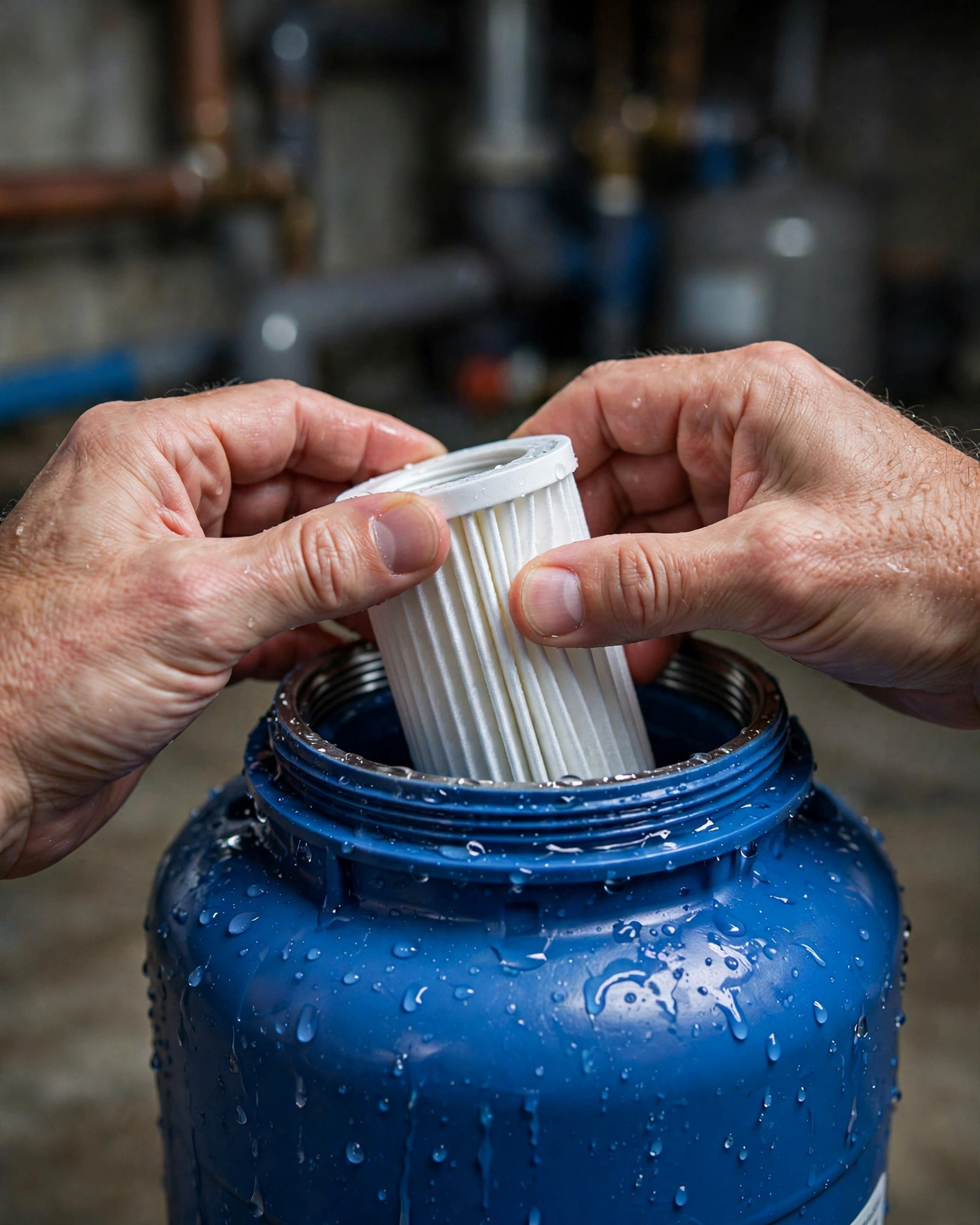
3. The maintenance. Cartridge systems need new cartridges roughly every 6–12 months at roughly $100–160 a year for a typical set. Tank systems need very little within their rated media life — typically just the sediment filter every 6–9 months, around $40 a year — which is the point of the premium.
Five-year math
| Setup | Upfront (unit + install) | Yearly maintenance | 5-year total* |
|---|---|---|---|
| Budget cartridge system | ~$500 + ~$500 install | ~$160/yr cartridges | ~$1,800 |
| Tank system (SpringWell CF1-class) | ~$1,100 + ~$500 install | ~$40/yr (sediment filter) | ~$1,800 |
| Pitcher filter (for comparison) | ~$30 | ~$60/yr cartridges | ~$330 |
*Rough estimates — cartridge prices, install rates, and schedules vary by brand and household.
Two takeaways. First, the five-year gap between budget and premium nearly disappears — the tank’s higher sticker is absorbed by years without cartridge bills, while the budget system’s cartridges are a subscription you never cancel. What the extra money really buys is maintenance freedom and flow-rate headroom, not a cheaper lifetime total. Second, a pitcher filter looks dramatically cheaper, but it only treats drinking water; many households also quietly spend roughly $80–100 a year on fridge-filter replacements alone.
And if your current “system” is cases of bottled water: even modest bottled-water spending adds up to several hundred dollars a year — a whole-house filter pays for itself against that baseline while also covering showers, laundry, and appliances. Bottled water treats one glass; a main-line filter treats the house.
Troubleshooting Common Problems
Most whole-house filter problems announce themselves clearly. Work through these in order before calling anyone.
Pressure dropped after install
The number-one complaint, and usually one of two causes: an undersized unit, or a sediment cartridge already loaded with grit and choking flow. Check the pre-filter first — if it’s brown and packed, a swap is cheap. If pressure was low from day one with fresh cartridges, the flow rating is below your home’s peak demand: that’s the sizing problem from the section above, and upsizing (or adding a parallel pre-filter) is the real fix.
Bad taste or odor came back early
Carbon gets exhausted — that’s its job. If chlorine taste returns well before the scheduled change, your water may carry more chlorine than average, or the cartridge’s capacity is smaller than your usage. Two honest fixes: shorten the replacement interval, or step up to a larger carbon stage. What you should not do is ignore it — an exhausted cartridge can release trapped contaminants back into the water and can harbor bacterial growth.
Sediment getting through
If grit shows up downstream, suspect the seal before the media: a pinched or dried-out o-ring on a cartridge housing lets water bypass the filter entirely. Reseat the cartridge, inspect the o-ring, and torque the housing to the manufacturer’s spec — hand-tight plus the housing wrench, not gorilla-tight. If the seal is fine, the micron rating may be too coarse and a finer pre-filter is the fix.
Leaks at the fittings
Slow drips at threaded connections usually mean the threads need resealing (plumber’s tape or pipe dope, applied correctly) or a fitting worked loose. Tighten gently, recheck, and watch it for a day. A leak that persists — or any spray, not a drip — means shut the bypass valves and call a plumber. Main-line leaks don’t improve with patience.
When to replace vs when to call a plumber
Replace the cartridge yourself when the symptom is flow, taste, or schedule — that’s maintenance, not repairs. Call a plumber when the symptom is plumbing: persistent leaks, cracked housings, pressure problems that survive fresh cartridges, or a main shutoff valve you don’t fully trust. A service call costs far less than a flooded utility room.

One diagnostic tip worth its weight: if only your kitchen water tastes off while the rest of the house is fine, the problem is probably point-of-use — the faucet, the fridge line, or the last feet of pipe. That’s under-sink RO territory, not another main-line filter.
Whole-House Filter FAQs
Will a whole-house water filter soften hard water?
No — not on its own. A whole-house filter targets sediment, chlorine taste, and odor. Hardness (calcium and magnesium) is handled by a water softener, which uses a different process called ion exchange. Many homes run both: filter first, softener after. Be skeptical of any filter ad promising softer-feeling water without a softener stage.
Do whole-house filters remove lead?
Only if the system is specifically designed and tested for it — never assume. Look up the exact model in the NSF public database (info.nsf.org) and check for a lead-reduction listing under NSF/ANSI 53. If there’s no listing for that model, treat any lead claim on the brand’s page as unverified marketing.
How often do I change whole-house filter cartridges?
Cartridge systems: typically every 6–12 months — sooner for sediment-heavy or iron-heavy water. Tank media is usually rated for years; replace when the brand’s rated life runs out or performance slips. A pressure drop, returning taste or odor, or visible sediment mean the media is done regardless of the calendar.
Do I need a water softener and a whole-house filter?
Only if you have both problems. Chlorine taste without hardness: a filter alone. Iron plus hardness: a filter for the iron, a softener for the hardness. Test first — buying both blind is the expensive route.
Can I install a whole-house filter myself, or do I need a plumber?
It’s plumbing on your main water line, so most people hire a licensed plumber — typically a few hundred dollars of labor. A bad install can flood a basement or starve the whole house of pressure. Confident DIYers with working shutoff valves do install cartridge systems themselves; tank systems usually justify a professional.
If I have a whole-house filter, do I still need a pitcher or under-sink filter?
Maybe. A whole-house filter handles general issues like sediment and chlorine taste, but it doesn’t guarantee the deepest drinking-water filtration. If drinking water is your only concern, a pitcher or under-sink unit alone may be enough — and if you already have a whole-house system, a point-of-use filter at the kitchen tap adds an extra stage.
How much does a whole-house water filter cost per year?
Roughly: cartridge systems run about $100–160 a year in replacement cartridges; tank systems run around $40 a year in sediment-filter upkeep within their rated media life. Over five years, both often land around $1,700–1,900 including install — the budget unit’s cartridge bills erase its sticker advantage. Treat these as starting estimates, not quotes.
Conclusion
Match the system to your water source first — city water wants chlorine and taste handled, well water needs iron and sediment addressed. Size by peak flow rate, not just house size, so showers stay strong. And before trusting any contaminant claim, look the exact model up in the NSF public database. Get those three right and the system fades into the background — which is the whole point.


