


Express Water Whole House Water Filter Review (2026): Is It Worth It?
★ 3-STAGE WHOLE-HOUSE REVIEWThe chlorine smell hits you the moment the shower runs hot. The ice cubes from the freezer taste faintly of a swimming pool. And somewhere in the back of your mind is the plumbing question nobody wants to think about: what is leaching out of the old pipes between the street and your faucet? A pitcher filter handles the drinking glass — but it does nothing for the shower, the laundry, or the water your kids bathe in.
That is the exact gap the Express Water 3-Stage Whole House Filter System is built for. It sits on your home’s main water line and filters everything coming in — chlorine and chloramine, sediment, and, in the Heavy Metal version, heavy metals like lead and iron — using three big 20-inch cartridges on a freestanding stainless steel frame. It is a well-built, genuinely practical system with the easiest filter swaps in its price range, but its contaminant claims are not independently certified, and many buyers misunderstand what a whole-house cartridge filter can and cannot do. This review covers what the system does, what it costs year after year, and what owners complain about.
Our scores
Table of Contents
Quick verdict
The bottom line: the Express Water 3-Stage is a solid, well-built way to take chlorine, chloramine, sediment, and (in the Heavy Metal version) heavy metals out of every tap — with the friendliest cartridge swaps in its price range. It is not independently certified for those claims, and it does not reduce dissolved minerals or soften water. Right for municipal-water homeowners who want broad protection without a four-figure system; wrong for hard-water or high-TDS problems.
Verdict: a practical workhorse for chlorine-heavy and older-plumbing homes — don’t buy it for problems it was never designed to solve.
Price checked at time of writing (around $300–400 for the Heavy Metal 3-stage, an estimate); it changes often — see the live price before you buy.

Why you should trust this review
We did not receive a test unit and we did not run a lab bench test. Claiming hands-on testing we never did would be dishonest, so we will not do it. What we did instead was research and comparison: we read the brand’s own product documentation, compared it against the three whole-house systems buyers cross-shop most, and checked its certification claims against the public NSF and WQA databases — where we could not confirm a listing. Where a claim could not be verified, we say so outright.
How we researched
- Read Express Water’s own product documentation — the brand’s whole-house walkthrough pages, which describe the five 3-stage variants and the filter media each uses.
- Compared specs across 4 whole-house systems — against the iSpring WGB32B, Aquasana Rhino EQ-1000, and PRO+AQUA Elite PRO-100-E GEN2.
- Checked certification claims against the certifiers’ databases — looking for this system in the public NSF (info.nsf.org) and WQA listings. We could not confirm a listing, and we refuse to dress that up.
Pros and cons
Pros
- Filters every tap in the house — one system on the main line covers showers, laundry, and drinking water; no pitcher or faucet filter can do that.
- Heavy Metal version targets old-pipe concerns — sediment + KDF + carbon block stages aimed at lead, iron, chromium, and arsenic, per the brand’s stated design.
- Freestanding stainless steel frame — no wall to drill into; it stands on its own and the steel frame is genuinely sturdy.
- Easiest filter swaps in the price class — a pressure gauge on each stage plus release buttons, so you see when cartridges are clogging and depressurize housings without tools.
- Full filter set included in the box — a complete set of cartridges, not housings you have to fill up yourself.
Cons
- No independent certification we could verify — contaminant claims are brand-stated; we found no NSF/ANSI or WQA listing (see Certifications).
- Does not reduce TDS or soften water — dissolved minerals and hardness pass straight through; the brand itself says so.
- Bulky and heavy — a three-canister bank on a steel frame takes real floor space, around 63 pounds.
- Cartridge costs add up — a full 3-cartridge replacement set runs roughly $90–100 (street estimate), every 6–12 months.
- Real plumbing work to install — cutting into the main line with 1-inch connections; confident DIYers manage, others should budget for a plumber.
Certifications (what we could — and couldn’t — verify)
This is the section most reviews gloss over, so we will be blunt: we could not confirm an independent NSF/ANSI or WQA certification listing for this system. We searched the public NSF database (info.nsf.org) and WQA listings and found no entry. That does not prove the system fails any test — but it means its contaminant claims are brand-stated, not third-party certified. For heavy-metal and lead claims, that distinction matters: nobody can verify performance from the kitchen sink.

What the brand does state, on its own product pages and retailer listings: the Heavy Metal version’s three stages are a sediment filter, a KDF stage (kinetic degradation fluxion — copper-zinc granules with catalytic carbon), and an activated carbon block. The brand describes the KDF stage as targeting heavy metals including lead, nickel, chromium, and arsenic, and the carbon stages as addressing chlorine, chloramines, VOCs, and taste and odor. Some third-party review sites repeat a claim that the system is “compliant with ANSI 58” — that standard governs reverse osmosis, and the claim appears on only one such site, so we treated it as unreliable and did not repeat it as fact.
| Contaminant / claim | Claimed basis | Verification status |
|---|---|---|
| Lead, arsenic, chromium (Heavy Metal version) | Brand-stated (KDF stage) | Unverified — no certifier listing found |
| Chlorine / chloramine taste and odor | Brand-stated (carbon stages) | Unverified — standard carbon function, no certifier listing found |
| Sediment, rust, silt | Brand-stated (sediment stage) | Unverified — standard mechanical filtration, no certifier listing found |
| “ANSI 58 compliant” (per one review site) | Third-party site claim | Rejected — unreliable single source; ANSI 58 is an RO standard |
| NSF/ANSI 42, 53, or 401 | Not claimed by the brand | Not found — no listing in NSF/WQA databases |
If a seller or review page tells you a whole-house system is “certified” for a specific contaminant, ask for the certifier name and listing number — real NSF or WQA listings are publicly searchable. A certification claim without a searchable listing is marketing copy, not certification. If lead is your concern, test your water first; no uncertified system should be the basis of a health decision.
Design and usability
The Express Water 3-Stage is built around a simple idea: a whole-house system that does not need to be bolted to a wall. Three tall 20-inch housings — the industry-standard “Big Blue” style — sit side by side in a freestanding stainless steel frame, plumbed with 1-inch inlet and outlet connections. The brand rates flow at up to about 15–17 gallons per minute (sources vary slightly), plenty for a typical household; you will not notice the shower weakening because the filter is in the line.
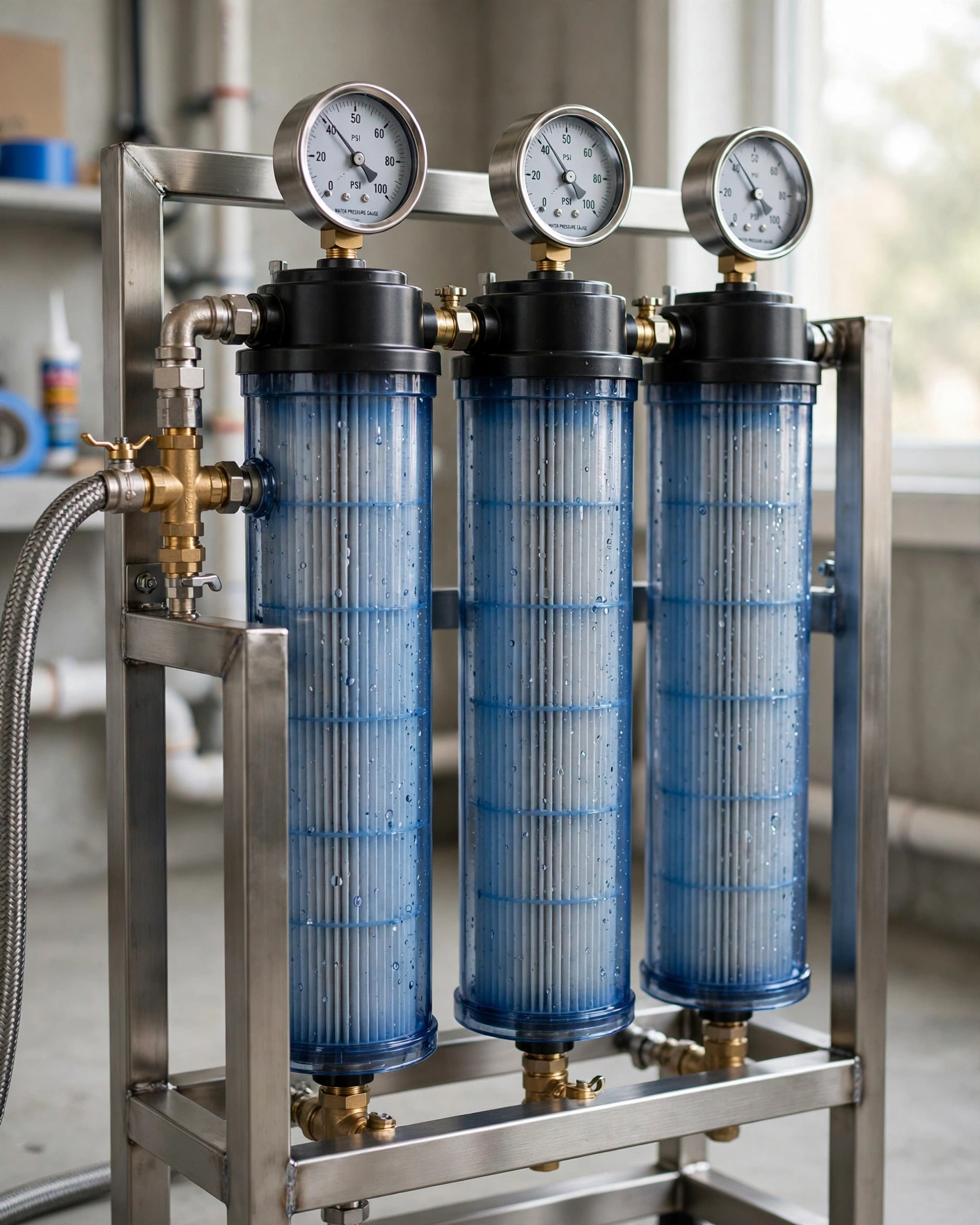
The standout detail is the per-stage pressure gauge with a release button on each housing: when the first-stage gauge reads noticeably lower than the last, the sediment cartridge is clogging and it is time for a change. The release buttons let you depressurize a housing before unscrewing it — the step that turns cartridge changes into a wrestling match on systems without them. Owners consistently call this out as the system’s best feature.
Installation is where expectations need managing. “Freestanding” does not mean “no plumbing” — the unit still goes on your main water line, which means cutting the pipe and connecting 1-inch fittings, usually where the line enters the house or in a garage or utility room. The housings arrive with a full filter set; owners with basic plumbing skills report doing it themselves over a weekend, while others hire a plumber. The whole unit is heavy — roughly 63 pounds per third-party figures — so plan the location before it arrives. If you want a cheaper 3-stage with a wall-mount design instead, our iSpring WGB32B review covers the value alternative.
Filter cost math
The sticker price is the least important number on this page. What matters is the yearly cost of running the thing, because a whole-house system is a subscription you pay in cartridges:

| Item | Express Water 3-Stage |
|---|---|
| System (upfront) | ~$300–400 (Heavy Metal version, street estimate) |
| Cartridge rated life | 100,000 gallons or 6–12 months |
| Full cartridge sets per year | 1–2 |
| Replacement set price (3 cartridges) | ~$90–100 (one-retailer snapshot, estimate) |
| Estimated yearly cartridge cost | ~$90–200 |
| 5-year cost of ownership (system + cartridges) | ~$750–1,400 (estimate) |
Two things jump out. First, the 100,000-gallon rating is a best-case number: the brand itself says filter life depends on incoming water quality, and in sediment-heavy or well-water conditions owners report changing cartridges closer to the 6-month mark — so watch the gauges, not the calendar. Second, the running cost is the honest middle of the category: far cheaper than premium tank systems, but more than a budget 3-stage like the iSpring. Over five years the Express Water lands around ~$750–1,400 (estimate), which is reasonable for what it covers. All figures are estimates from current street prices.
What owners complain about
It is bigger and heavier than expected. The number-one recurring theme: buyers underestimate the footprint of a three-housing bank on a steel frame and the weight (around 63 pounds per third-party figures). Measure your installation spot before ordering.

Installation is not as “easy” as the marketing implies. Many owners install it themselves without trouble, but a consistent thread of complaints comes from buyers who expected a quick hookup and found themselves cutting into a main line with 1-inch fittings for the first time. Confident DIYers are fine; if you have never threaded a pipe fitting, budget for a plumber.
Filter life varies a lot by water quality. The 100,000-gallon / 6–12-month rating assumes average municipal water. Owners on well water or with heavy sediment report the first-stage cartridge loading up much faster — exactly what a sediment pre-filter is for, but the “~once a year” expectation from the marketing does not hold for everyone.
The TDS misunderstanding. A recurring disappointment pattern: buyers expecting the system to lower total dissolved solids or soften hard water, then discovering — as the brand itself states — that whole-house cartridge systems do not reduce TDS. If your test strip shows high hardness, you need a softener, not this filter.
None of these are hidden gotchas, and most are true of the whole-house category in general. But they are the real-world friction points, and you are better off knowing them now.
Express Water vs rivals
Numbers in a vacuum mean little, so here is the Express Water 3-Stage against the three whole-house systems buyers cross-shop most — drawn from published specs and brand-stated ratings, all re-checked by our verifier.

| Express Water 3-Stage | iSpring WGB32B | Aquasana Rhino EQ-1000 | PRO+AQUA Elite PRO-100-E GEN2 | |
|---|---|---|---|---|
| Typical system price | ~$300–400 (estimate) | ~$230–280 | ~$900–1,100 | ~$300–450 |
| Cartridge/tank rated life | 100,000 gal / 6–12 mo | 100,000 gal / ~12 mo | 1,000,000 gal / ~10 yr | ~6–12 mo cartridges |
| Stages | 3 (sediment, KDF, carbon block) | 3 (sediment, carbon block ×2) | Multi-stage tank (carbon + KDF) | 3-stage |
| Certifications (brand-stated) | None verified | None verified | Brand states NSF 42/53/401 — see our verification | None verified |
| Flow rate | ~15–17 GPM | 15 GPM | 7 GPM | ~12 GPM |
| Mounting | Freestanding steel frame | Wall-mounted | Floor-standing tank | Wall-mounted |
| Best for | Heavy-metal worries + easy filter swaps | Budget municipal-water filtration | Long-life, low-maintenance filtration | Well-water budgets |
The pattern is clear: the iSpring WGB32B is the direct budget rival — same 3-stage cartridge concept, lower price, wall-mounted instead of freestanding. The Aquasana Rhino is a different class: a million-gallon tank system costing three times as much but running for a decade with minimal maintenance. The Express Water sits in the middle — freestanding frame, KDF heavy-metal stage, gauge-per-stage maintenance design. Comparing tank systems too? See our SpringWell CF1 review, SpringWell whole-house review, and Aquasana HealthShield review.
Who should buy it

Buy it if
- You are on municipal water with chlorine or chloramine and want better water at every tap — shower, laundry, and drinking water — not just the kitchen.
- You have older plumbing and heavy-metal worries — the Heavy Metal version’s KDF stage is aimed at exactly this (get a water test to confirm what is actually in your water).
- You want hassle-free filter changes — the gauges and release buttons make maintenance genuinely easy.
- You cannot or do not want to wall-mount — the freestanding frame needs floor space, not a load-bearing wall.
Skip it if
- Your main problem is hard water or high TDS — this system does not reduce dissolved minerals; you need a softener or RO, not a cartridge filter.
- You need independently certified contaminant reduction — we could not verify an NSF/ANSI or WQA listing for this system.
- You want a decade of near-zero maintenance — tank systems like the Aquasana Rhino cost more upfront but run for years without cartridge swaps.
The specs
- Brand
- Express Water
- Model (reviewed)
- 3-Stage Whole House (Heavy Metal version)
- Stages
- 3: sediment, KDF, carbon block
- Cartridge rated life
- 100,000 gallons / 6–12 months
- Flow rate
- ~15–17 GPM (brand-stated)
- Connections
- 1-inch inlet/outlet
- Frame
- Freestanding stainless steel
- Monitoring
- Pressure gauge + release button per stage
- TDS reduction
- None (brand-stated)
- Certifications
- None independently verified
- Typical system price
- ~$300–400 (estimate)
- Warranty
- 1-year limited (third-party figure)
FAQs
Does the Express Water whole house filter remove lead?
The Heavy Metal version uses a KDF stage that the brand describes as targeting heavy metals including lead, arsenic, and chromium — but we could not find an independent NSF/ANSI or WQA certification listing for this system, so the claim is brand-stated, not certified. If lead is your concern, get your water tested first.
Does the Express Water whole house system reduce TDS?
No. The brand states this explicitly: whole-house cartridge systems sit on the main line and, unlike reverse osmosis systems, do not reduce total dissolved solids. If your water report shows high TDS or hardness, this is the wrong product category — you need an RO system or a softener.
How often do the filters need to be changed?
The brand rates the cartridge set at 100,000 gallons or 6–12 months, depending on incoming water quality. Sediment-heavy water shortens that toward the 6-month mark. The practical guide is the pressure gauges: when the first-stage gauge reads noticeably lower than the last, the sediment cartridge is clogging and it is time for a change.
Is the Express Water whole house filter NSF certified?
We could not confirm an NSF/ANSI or WQA listing for this system in the certifiers’ public databases. Some third-party review sites repeat an “ANSI 58 compliant” claim, but that standard governs reverse osmosis and the claim appears on only one site — we treated it as unreliable. Real certification listings are publicly searchable at info.nsf.org.
What is the difference between the Heavy Metal and Ultimate Protection versions?
Both are 3-stage systems on the same freestanding frame. The Heavy Metal version uses a sediment + KDF + carbon block set aimed at heavy metals, chlorine, and chloramines. The Ultimate Protection version targets a broader list including VOCs, pharmaceuticals, and industrial solvents, per the brand’s walkthrough. Express Water also sells Anti-Scale, Standard, and Iron & Manganese variants — pick the set that matches your water report.
Will it soften hard water?
No. This is a filter, not a softener — dissolved hardness minerals pass through it. The Anti-Scale variant uses a polyphosphate cartridge the brand describes as helping protect pipes from scale buildup, but that is not the same as removing hardness. If hard water is your problem, look at softeners.
How much does it cost per year to run?
Expect roughly $90–200 per year in replacement cartridges (estimate): a full 3-cartridge set runs about $90–100 at street prices, and you will use one to two sets a year depending on water quality. Over five years, system plus cartridges lands around $750–1,400 — all estimates, and prices change often.
Conclusion
The Express Water 3-Stage earns its place as the practical middle of the whole-house market: chlorine, chloramine, sediment, and (in the Heavy Metal version) heavy metals at every tap, on a sturdy freestanding frame, with the easiest filter swaps in its price range. Its honest weaknesses are the missing independent certification, no TDS reduction, and running costs that reward owners who watch the gauges. Buy it for the problems it solves — skip it for the ones it does not.
Price checked at time of writing; it changes often — see the live price before you buy.
Update log
- Zulqarnain: Review published.