
Aquasana Rhino Review (2026): Is It Worth It?
★ WHOLE-HOUSE REVIEWYour tap water smells faintly of chlorine — not just at the kitchen sink, but in the shower, the laundry room, every tap in the house. A pitcher filter fixes one glass at a time, which feels pointless when the whole house runs on the same chlorinated city water. So the Aquasana Rhino keeps coming up: a twin-tank system that treats water at the point of entry, rated for a million gallons over up to ten years.
Here is the short answer after researching and comparing specs, certifications, and owner reports: the Rhino is a solid, low-drama chlorine and sediment filter for city-water homes — and a bad buy for well water, hard water, or anyone expecting it to soften water or strip dissolved solids. Its certification is narrower than many retail pages suggest, and the pre/post filter subscription is the real cost of ownership. This review covers what the Rhino is certified to do, what owners complain about, and what it costs over ten years — so you can decide before a plumber cuts into your main line.
Our scores
Table of Contents
Quick verdict
The bottom line: the Aquasana Rhino EQ-1000 is a low-maintenance whole-house filter for municipal water where chlorine taste and odor are the main problem. Its million-gallon tank media rating means the core can run for up to a decade without a media change — something cartridge-based units cannot match. But the certification is narrow (chlorine and tank safety only), and the pre/post filters need changing roughly every two months, which is the subscription cost nobody puts in the headline.
Verdict: worth it for chlorine-heavy city water and long-term homeowners; a costly mistake for well water, hard water, or lead concerns.
Price checked at time of writing; it changes often — see the live price before you buy.

Why you should trust this review
We did not receive a test unit and we did not run a lab bench test. Claiming hands-on testing we never did would be dishonest, so we will not do it.
What we did instead was research and comparison: we pulled the manufacturer’s spec sheets and warranty documents, checked every certification claim against Aquasana’s own published certification listings (and caught retail pages overstating them), read owner reviews to find the complaints that keep repeating, and ran the ten-year ownership math from real filter prices and rated change intervals. Every section says what it is based on, so you can check the reasoning yourself.
How we researched
- Compared specs across 5 whole-house systems — the Rhino EQ-1000 against the Aquasana HealthShield, a PRO+AQUA whole-house unit, the iSpring WGB32B, and an Express Water whole-house system.
- Checked certification claims against Aquasana’s own certification page — several retail and review pages credit the Rhino with NSF/ANSI 42, 53, and 401. The brand’s listing shows 42 and 61 only, so this review does not repeat the 53/401 claims.
- Read owner reviews and complaint threads — across major retail listings, looking for recurring issues, not one-off bad experiences.
- Calculated ten-year ownership math — from the system price, typical plumber installation estimates, and pre/post filter pricing at the rated ~2-month change interval. All figures are estimates, labeled as such.
Pros and cons
Pros
- Million-gallon tank media — rated at 1,000,000 gallons or up to 10 years (manufacturer-stated), far longer than cartridge-based whole-house units that need full media swaps.
- Genuinely low-drama upkeep — no salt to refill, no backwash cycles, no drain line, per the manufacturer’s design specs.
- Chlorine taste and odor improvement at every tap — the brand claims 97% chlorine reduction; owners consistently report the pool-smell disappearing from showers and sinks.
- Rated 7 GPM with minimal pressure drop — sized for typical households without the shower going weak when the dishwasher runs (manufacturer-stated).
- 10-year limited warranty on the main tank — longer tank coverage than most cartridge-housing competitors, per the brand’s published warranty terms.
Cons
- Narrow certification — NSF/ANSI 42 (chlorine reduction) and 61 (tank) only, per Aquasana’s certification page. No lead, no pharmaceuticals, despite what some retail pages imply.
- The pre/post filter subscription — retail listings and owner reports put changes at roughly every 2 months, which is the real recurring cost.
- Professional installation is a project — it cuts into the main water line, and typical plumber quotes run ~$200–600 (estimate).
- Does nothing for hard water or TDS — no softening, no dissolved-solids reduction; wrong product for well water or hardness problems.
Certifications (database-checked)
This section is where the Rhino review gets honest, because this is where the internet gets sloppy. Several retail and review pages credit the Rhino with NSF/ANSI 42, 53, and 401 — which would mean certified health-effect contaminant reduction. We checked Aquasana’s own certification page: it lists 42 and 61 only. The table below reflects the brand’s listing, with the overstated third-party claims marked as refuted rather than repeated.
| Claim | Certification | Status |
|---|---|---|
| Chlorine taste and odor reduction (system) | NSF/ANSI 42 | Listed — Aquasana certification page |
| Tank materials and structural safety | NSF/ANSI 61 | Listed — Aquasana certification page |
| Health-effect contaminants such as lead (NSF/ANSI 53) | Claimed by some retail/review pages | Not listed — claim refuted |
| Pharmaceuticals and emerging compounds (NSF/ANSI 401) | Claimed by some retail/review pages | Not listed — claim refuted |
Certification covers only the contaminants in the listing, and only under NSF’s test conditions. If lead, PFAS, or pharmaceuticals are your concern, the Rhino is the wrong product regardless of what a retail bullet point says — start with a water test and look at systems certified for those specific contaminants.
Design and usability
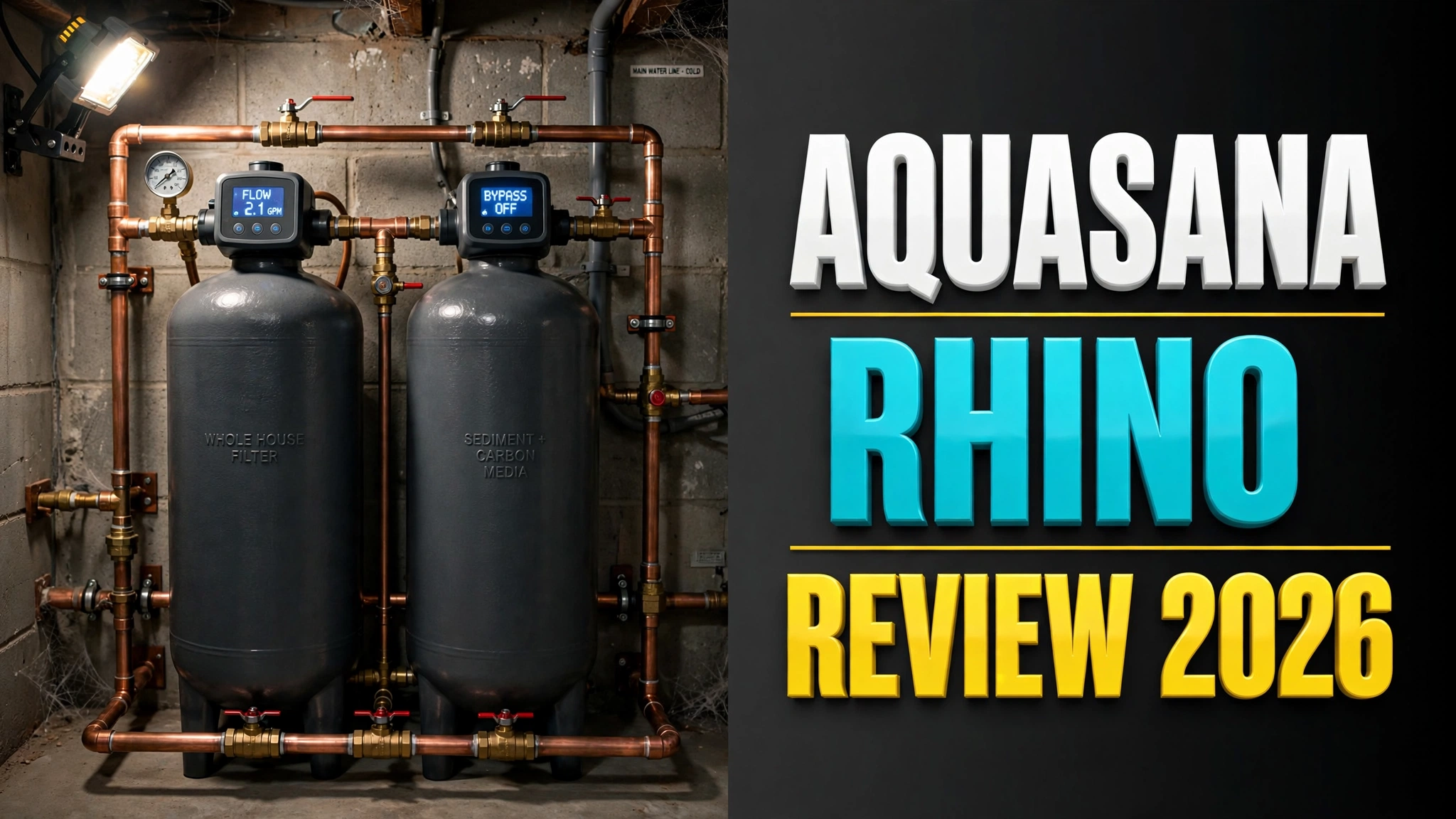
Water enters through a 20-inch sediment pre-filter, flows up through the main tank — activated and catalytic carbon plus KDF copper-zinc media (manufacturer-stated) — and exits through a carbon post-filter. The upflow design is the brand’s answer to channeling and clogging: water rises through the media bed instead of packing it down, which is how the tank media earns its long rated life. The system is rated at 7 GPM, covering a typical household’s simultaneous shower-plus-appliance demand without a noticeable pressure drop, per the manufacturer’s specs.

Usability is the Rhino’s quiet strength: nothing to program, no salt to haul, no backwash cycle to schedule, no drain connection needed. You change the pre/post cartridges, and the tank media keeps working. The honest tradeoff is physical: the tanks are tall and need a real chunk of utility-room or basement wall on the main water line, with clearance to swing the filter housings open. Measure your space before the freight delivery arrives.
Tank-based whole-house design is not unique to Aquasana — the iSpring WGB32B follows a similar concept with different media and a shorter tank story — but the Rhino’s million-gallon rating is the longest in its price class that we found in manufacturer specs.
Filter cost math
The system price is the least important number on this page. The Rhino’s tank media is rated for a decade, but the pre/post cartridges are a subscription — and that subscription is where the ownership cost actually lives:

| Item | Estimate |
|---|---|
| Rhino EQ-1000 system | ~$900–1,100 |
| Professional installation (plumber) | ~$200–600 |
| Pre/post filter set, per change | ~$60–80 |
| Changes per year (roughly every 2 months) | ~6 |
| Estimated yearly filter cost | ~$360–480 |
| Estimated 10-year total | ~$4,700–6,500 |
Two things jump out. First, the filter subscription dwarfs the system price over a decade — roughly four to five times the upfront cost. Anyone selling you this system on the “set and forget for ten years” line is describing the tank media, not your wallet. Second, the math only works if the tank media actually survives its rating in your water: heavy sediment loads wear pre-filters faster, which pushes the yearly number up. Budget the high end if your municipal water runs dirty. (Every figure here is an estimate from current street pricing — re-check before you buy.)
What owners complain about

The filter subscription is the real price. The top recurring theme in owner feedback: the pre/post cartridges need changing far more often than the “ten-year system” marketing suggests. Roughly every two months is the reported rhythm, and owners who skip changes report flow and taste slipping — an exhausted pre-filter protects nothing.
Installation is a project, not a purchase. The system ships in multiple boxes via freight, the tanks are tall and heavy, and the install means cutting into the main water line. Most owners hire a licensed plumber (~$200–600 estimate). Budget the install like a small renovation, not an appliance delivery.
It will not fix hard water. A persistent disappointment thread: buyers in hard-water areas expect softer-feeling water and get none — no salt, no ion exchange, no scale reduction. If hardness is your problem, you need a softener or scale-control system, not this.
Warranty fine print. The 10-year headline covers the main tank only. The pre/post filter housings are covered for 12 months, labor is not covered, and the warranty is non-transferable — it does not follow the system to a new homeowner, per the brand’s published warranty terms.
Not a well-water system. The Rhino is designed for chlorinated municipal water. Well owners with heavy sediment, iron, or sulfur report overwhelmed pre-filters and short change intervals — the wrong tool for that water profile.
Aquasana Rhino vs rivals
Numbers in a vacuum mean little, so here is the Rhino against the systems buyers cross-shop most — drawn from published specs and brand-stated certifications, re-checked rather than repeated from retail pages.

| Rhino EQ-1000 | Aquasana HealthShield | PRO+AQUA whole-house | |
|---|---|---|---|
| Typical system price | ~$900–1,100 | ~$1,900–2,300 | ~$300–450 |
| What it targets | Chlorine, sediment, taste/odor | Rhino-style filtration + UV + salt-free scale control | Budget whole-house filtration |
| Certifications | NSF/ANSI 42 + 61 (verified listing) | Brand-stated; not database-verified here | Not database-verified |
| Tank/media life | 1M gallons / up to 10 yrs (mfr-stated) | Brand-stated long-life tanks | Cartridge-based; shorter cycles |
| Install | Plumber recommended | Plumber recommended | More DIY-friendly |
| Best for | Chlorine-heavy city water, long-term owners | Buyers wanting UV + scale control in one box | Tight budgets, basic filtration |
The pattern is clear: the Rhino is the focused chlorine/sediment workhorse in the middle. The Aquasana HealthShield is the brand’s step-up bundle — roughly double the price (estimate), adding a UV sterilizer and salt-free scale control for buyers who want one box to do more. The PRO+AQUA unit is the budget play at a third of the price, but with cartridge-based media, shorter cycles, and no verified certifications we could find. If your shortlist includes other tank-based systems, our Express Water whole-house review covers another popular alternative in this price band.
Price checked at time of writing; it changes often — see the live price before you buy.
Who should buy it
Buy it if
- You are on chlorinated municipal water and want better taste and odor at every tap, not just the kitchen sink.
- You plan to stay in the home for years — the million-gallon tank rating pays off over a long ownership horizon.
- You want low-drama maintenance — no salt, no backwash, no programming, just pre/post cartridge swaps.
Skip it if
- You are on well water with sediment, iron, or sulfur — this system is designed for city water.
- You need softer water or lower TDS — the Rhino does neither; look at softeners or RO instead.
- Lead, PFAS, or pharmaceuticals are your concern — the Rhino carries no certifications for any of them.
- You want minimal ongoing cost — the ~2-month pre/post filter cycle is a real subscription.
If the Rhino’s narrow scope gives you pause, the broader whole-house field is worth a look before you commit — our SpringWell whole-house review covers another tank-based system buyers compare against the Rhino.
The specs
- Brand
- Aquasana
- Model
- Rhino EQ-1000
- Type
- Whole-house, point-of-entry
- Media
- Activated + catalytic carbon, KDF copper-zinc media (manufacturer-stated)
- Tank media rating
- 1,000,000 gallons / up to 10 years (manufacturer-stated)
- Rated flow
- 7 GPM (manufacturer-stated)
- Certifications
- NSF/ANSI 42 + 61 (Aquasana certification page)
- Warranty
- 10-yr limited, main tank; housings 12 months (brand warranty terms)
- Typical system price
- ~$900–1,100 (estimate)
- Install
- Plumber recommended; cuts into main water line
FAQs
How long do the Rhino’s filter tanks really last?
The manufacturer rates the tank media at 1,000,000 gallons or up to 10 years, whichever comes first. That is a tank-media rating, not a maintenance-free promise — the pre/post cartridges still need changing roughly every two months, and heavy sediment in your water shortens everything downstream of it.
Does the Aquasana Rhino remove lead?
No — it is not certified to. Aquasana’s certification page lists NSF/ANSI 42 (chlorine reduction) and 61 (tank safety) only; there is no 53 listing for lead or other health-effect contaminants. Some retail pages claim broader certification, but the brand’s own listing does not back that up. If lead is your concern, get a water test first.
Will the Rhino soften my water or reduce TDS?
No. The Rhino has no salt, no ion exchange, and no reverse-osmosis stage, so it does not soften water and does not reduce total dissolved solids. Limescale, spots on glassware, and hard-water feel will continue exactly as before. For hardness, you need a softener or scale-control system; for TDS, reverse osmosis.
How often do the pre/post filters need changing?
Retail listings and owner reports consistently put it at roughly every two months — six changes a year. That is the recurring cost to budget: a pre/post filter set runs an estimated ~$60–80 per change, so plan on roughly ~$360–480 a year in cartridges alone.
Can I install the Rhino myself?
It depends on your plumbing confidence. Installation means cutting into the main water line and mounting tall, heavy tanks — most owners hire a licensed plumber, with typical quotes around ~$200–600 (estimate). A bad main-line connection floods a basement, so this is not the project to learn plumbing on.
What is the difference between the Rhino and the Aquasana HealthShield?
The Rhino is Aquasana’s core whole-house chlorine/sediment system (~$900–1,100 estimate). The HealthShield is the step-up bundle (~$1,900–2,300 estimate) adding a UV sterilizer and salt-free scale control to the whole-house package. Our full HealthShield review breaks down that bundle in detail.
Can the Rhino be used on well water?
It is designed for chlorinated municipal water, not wells. Well water with heavy sediment, iron, or sulfur overwhelms the pre-filters and shortens change intervals dramatically — owners on wells consistently report this as a mismatch. Get a well-water test first and choose a system built for your actual water profile.
Conclusion
The Aquasana Rhino EQ-1000 is a specialist, not an all-rounder: a low-maintenance, long-lived chlorine and sediment filter for municipal water, with honest limitations everywhere else. Buy it for what it is certified to do — better-tasting, better-smelling water at every tap for up to a decade of tank life — and budget the pre/post filter subscription like the real price it is. Buy it for lead, hardness, TDS, or well water, and you will have spent a thousand dollars learning what the certification page already says.
Price checked at time of writing; it changes often — see the live price before you buy.
Update log
- Zulqarnain: Review published.